
Philippe the Original · Chinatown, Los Angeles
The freeway was coming. The family moved the restaurant.
Philippe’s French-dip origin story is disputed. The decision that kept it alive in 1951 is a story worth telling.
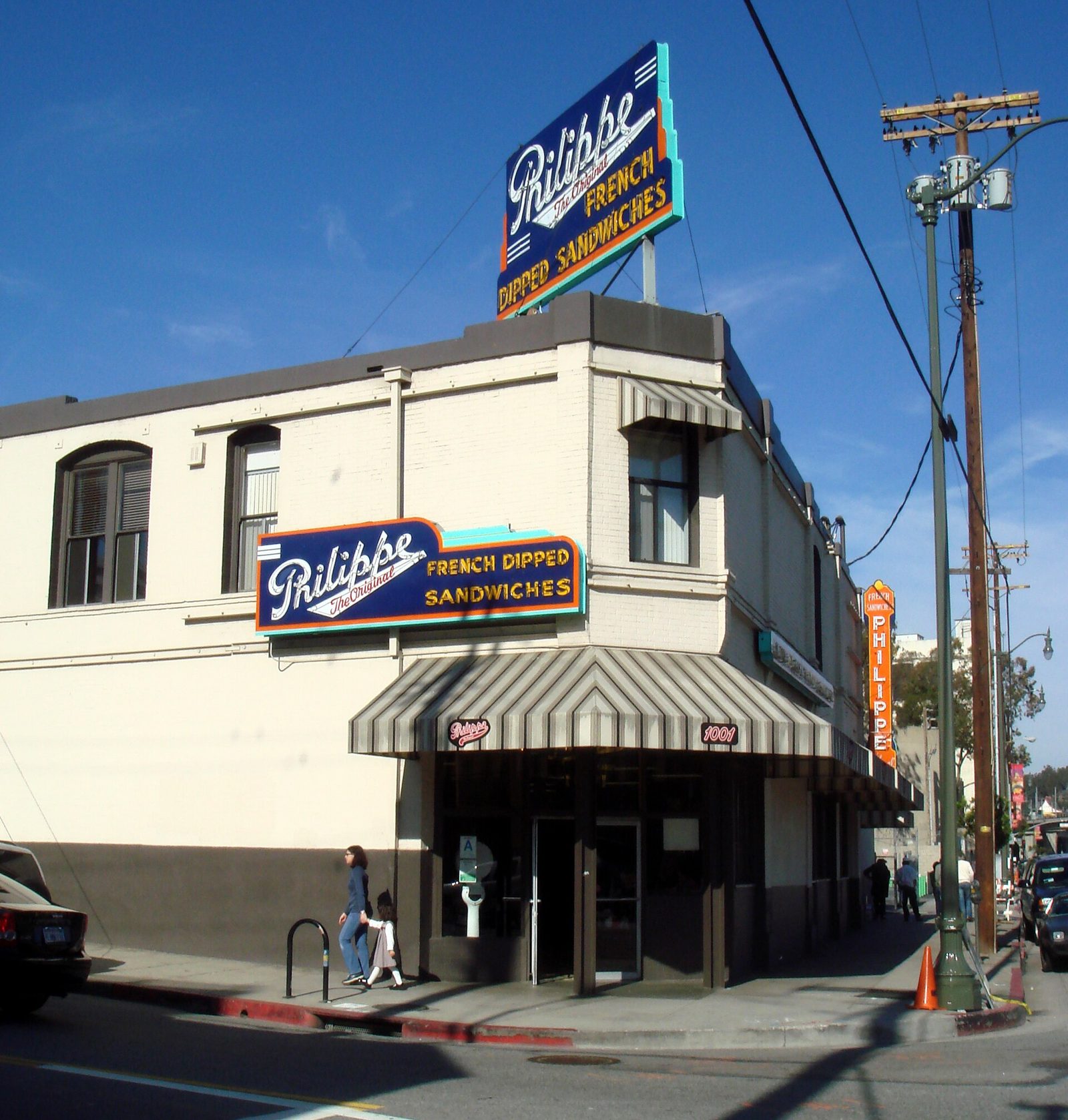
In 1951, freeway construction threatened to take Philippe’s Aliso Street restaurant. The family considered closing.
Bill Binder, who had married into the family, argued for moving it instead.
A restaurant can leave its building
The family found space at 1001 North Alameda Street, in a former machine shop with rooms upstairs.
They brought the business there. Customers could keep ordering sandwiches. The move is why Philippe the Original still has a counter near Chinatown and Union Station.
Philippe’s and Cole’s have long told competing stories about inventing the French dip: sliced meat on a roll dipped in the juices from roasting. Even Philippe’s own versions disagree about who the customer was and how the first dip happened.
Two restaurants claimed the French dip for 100 years. At least once, they told the same story.
What the customer carries away
You order at the long counter. A carver prepares the sandwich. Then you take it to the shared tables.
The menu offers different levels of dipping, from a little juice to a very wet roll. The house mustard supplies a much sharper surprise.
There's no horseradish in it, the FAQ says. It just tastes like there is.
Some familiar details have changed. In March 2026, the restaurant announced that it would retire its sawdust floor covering after discussions with its insurer.
A place can lose a detail and keep its purpose. Philippe’s had already demonstrated that on a much larger scale when it left an entire building behind.
The sandwich matters. So did the person who persuaded the family to give it another address.
Find the place
Philippe the Original is at 1001 North Alameda Street. Check its official menu and visitor information for hours, holiday closures and ordering. Seating is shared and first come, first served.
How we reported this · 28 sources
- The venue's website: philippes.com
- The venue's website: philippes.com
- The venue's website: philippes.com
- The venue's website: philippes.com
- The venue's website: philippes.com
- The venue's website: philippes.com
- The venue's website: philippes.com
- The venue's website: philippes.com
- The venue's website: philippes.com
- The venue's website: philippes.com
- Press coverage: laist.com
- Press coverage: nbclosangeles.com
- Press coverage: ktla.com
- Press coverage: pbssocal.org
- Press coverage: kqed.org
- Press coverage: tastingtable.com
- Press coverage: listserv.linguistlist.org
- Press coverage: kcur.org
- Press coverage: spectrumnews1.com
- Press coverage: en.wikipedia.org
- Press coverage: chowhound.com
- Press coverage: talesofthecocktail.org
- Press coverage: tastingtable.com
- Press coverage: lamag.com
- Press coverage: lamag.com
- Press coverage: nbclosangeles.com
- Press coverage: hoodline.com
- Press coverage: en.wikipedia.org
Pull a thread
Where this story goes next
Two restaurants claimed the French dip for 100 years. At least once, they told the same story.
Settle it
Who invented the French dip?
A century, no receipts
Philippe's and Cole's both dated themselves to 1908, and for a hundred years both said the French dip was theirs. Neither restaurant ever produced a document. Tasting Table called Cole's story entirely anecdotal, passed from employee to employee, and Philippe's own website admits that why the sandwich is called French is "lost to history." It was an argument run on oral history, and it ended without a ruling: Cole's served its last French dip on March 29, 2026, and Philippe's is still carving.
The same story, twice
Each side's legend kept changing. Philippe's website says the customer was a policeman; Andrew Binder, fourth generation of the owning family, told PBS SoCal a relative of the founder's said he was a fireman. Cole's told of a chef dipping a roll in jus for a customer with sore gums. Then in 1997, Tasting Table found, Cole's then-owner told the Los Angeles Times the bread had simply fallen into the gravy, which is the Philippe's story.
Two ways to dip
The sandwiches weren't even served the same way. Philippe's dips the roll before it reaches you, and its menu offers single-dipped, double-dipped or wet. Cole's, PBS SoCal noted, served the jus in a cup on the side.
What the newspapers show
A poster on the American Dialect Society's mailing list, in a thread transcribing the story, said the paper's first mention of a "dip" or "dipped" sandwich came only in 1930. On August 27, 1951, the Times ran a story on Philippe Mathieu as the Aliso Street restaurant bearing his name closed its doors, under a headline calling him the "Man Who Made First French-Dip Sandwich."
- Cole's French Dip The other claimant, closed since March 2026 1908-2026
- Philippe Mathieu The founder Philippe's credits with the first dip 1918
- Who invented the Mai Tai? Another LA origin fight that never got a ruling
The day California's beer ban ended in 1933, Cole's says it sold 19,000 gallons of beer.
Venue
Cole's French Dip
Built for the Red Cars
Cole's opened in 1908 on the ground floor of the Pacific Electric Building at Sixth and Main, the downtown terminal of the Red Car streetcars. Tales of the Cocktail put the foot traffic through the building at more than 100,000 people a day. Its founder (Henry Cole in most accounts, Harry in some) turned the doors of retired railcars into tabletops, Tales reported, and opened what it called LA's first check-cashing service inside the restaurant: in 1936 about 176,000 checks worth more than $7 million were cashed there. The last Red Car left the terminal in 1961. Cole's stayed.
Beer, regulars and a back office
By the restaurant's own account, repeated by LAmag and Tales of the Cocktail, it sold 19,000 gallons of beer on the day California lifted its ban in 1933. Charles Bukowski drank there in the 1960s and '70s, LAmag reported, and Tasting Table noted plaques honoring him and the gangster Mickey Cohen, who kept a regular table. The Varnish, a tiny cocktail bar in a converted storeroom next door, was once Cohen's "back office," Tales reported. The room turned up in Forrest Gump, The X-Files and NYPD Blue.
Its side of the dip
Cole's billed itself as the originator of the French dip. In its telling, a chef dipped bread in au jus in 1908 for a customer whose gums couldn't take a crusty roll. Philippe's, opened the same year, told a different story, and for more than a century neither could prove it. Cole's served the jus in a cup on the side.
A long goodbye
Cole's closed for the first time in its history in March 2007, when the nightlife group 213 Hospitality bought it, and reopened in December 2008 after a renovation NBC Los Angeles put at roughly $1.6 million, with the original wallpaper recreated digitally. The city had named it a Historic-Cultural Monument in 1989. On July 7, 2025, owner Cedd Moses announced it would close that August, citing the pandemic, the strikes, crime and rising costs. Farewell visits kept it going as the date was pushed back several times, to January 31, 2026, and finally to March 29, while the owners looked for a buyer to continue the Cole's legacy. It closed for good on March 29, 2026. "We just can't keep the doors open and keep hemorrhaging money," Moses told the Los Angeles Times.
Now · Closed since March 29, 2026. Its neon sign over Sixth Street is dark. The owners listed the business and the former Varnish space for about $500,000, hoping a buyer would keep the Cole's name; no reopening had been announced as of October 2026.
- Who invented the French dip? One of the two claimants
- Pacific Electric A Chinatown music room named for the same Red Cars
- Charles Bukowski A regular in the 1960s and '70s
In 2012 Philippe's raised its coffee from nine cents to 45. Regulars wanted to know what took so long.
Drink
Philippe's coffee
A nickel, then nine cents
When Philippe's opened in 1908, a cup of coffee cost a nickel, and the restaurant says it stayed a nickel until 1977, when it doubled to a dime. By 2012 a cup was nine cents. That January, NPR reported, the restaurant told the Los Angeles Times it could no longer keep up with the cost of coffee and would charge 45 cents, about 50 with tax. Regulars told the Times they didn't mind the 400 percent jump and wondered what took so long.
Birthday prices
On its 85th, 90th, 95th and 100th anniversaries, Philippe's sold French dips for a dime and coffee for a nickel for a few hours. For its 110th, in 2018, it sold beef, pork, ham and turkey dips for $1.10, one per person, with the USC Marching Band to open the party.
Now · The beverages menu on Philippe's website lists a cup of coffee at 46 cents (Gavina coffee), decaf at 75 cents and a 16-ounce to-go cup at $1.95.
- Philippe's hot mustard The other house tradition people come back for
Ben Lovett spent six years turning a Los Angeles warehouse into Pacific Electric. Some of the most revealing details are behind the stage.
Pacific Electric · Chinatown, Los Angeles
A musician built the backstage he wished he’d found on tour.
Ben Lovett spent six years turning a Los Angeles warehouse into Pacific Electric. Some of the most revealing details are behind the stage.
Read the story8 more threads
Order a chili size and you get the burger without the bun. A waiter's shout named it.
Dish
Chili size
Not quite a burger
Jack Smith described Ptomaine Tommy DeForest's size as a hamburger covered with chili and beans and sprinkled with chopped onions called violets or flowers. The bread came on the side, which, the Times noted, is what set it apart from a chili burger. As for the name, Smith said DeForest offered hamburger and steak sizes until the steak faded and the waiter simply hollered "Size!" The Homestead Museum says it came from the size of the ladle.
A quarter in 1928
By 1928 O'Dell's on South Figueroa sold a Size, a grilled hamburger smothered with chili and beans, for 25 cents, a Double Size for 35 and a Royal Size with spaghetti, chili beans and cheese for 40. In Santa Monica the Brae Mar Inn sold a Hamburger (Size) for a quarter.
At New Chinatown's first birthday in 1939, the cake was lettered "chop suey."
Place
Chinatown
The first Chinatown
The original Chinatown grew up around Alameda and Macy streets from the 1880s. It was demolished, from 1933, to make room for Union Station.
A plaza from the movies
New Chinatown opened for business in 1938. Community leader Peter Soo Hoo Sr. helped shape it, Hollywood set designers worked on it, and Cecil B. DeMille donated a prop. Its lanes were named Gin Ling Way, Bamboo Lane and Chung King Road, for Chongqing. At the first anniversary in 1939, a giant cake was served lettered "chop suey." Tyrus Wong painted a dragon mural in the plaza, restored by Fu Ding Cheng in 1984.
The neighbors
Phoenix Bakery opened the same year as the plaza and has been a Chan family business ever since; Philippe's is a neighbor on Alameda Street.
Now · Phoenix Bakery, open since the plaza's founding year, celebrated its 88th anniversary in 2026 at 969 North Broadway.
- Phoenix Bakery Baking here since the year New Chinatown opened since 1938
- Pacific Electric A music room in the neighborhood today
Hollywood began as a town that voted to ban liquor sales. Six years later it joined Los Angeles, for the water.
Place
Hollywood
A town that voted itself dry
Harvey Wilcox filed the name Hollywood with the county recorder in 1887; his wife, Daeida, said she chose it because it sounded nice and holly brings good luck. Hollywood incorporated as its own city in November 1903, by a vote of 88 to 77. Two months later its voters banned liquor sales except for medicine, 113 to 96, so its hotels and restaurants couldn't serve so much as a glass of wine with dinner. The independence didn't last. Hollywood merged with Los Angeles in February 1910 to get a reliable water supply and the city's sewers, and most of Prospect Avenue became Hollywood Boulevard.
Older than the sign
Frank's Cafe, the restaurant that became Musso & Frank, opened on Hollywood Boulevard on September 27, 1919, less than four months before national Prohibition began; one centennial history says the boulevard was still a dirt road. The HOLLYWOODLAND sign went up in the hills in 1923 to sell a housing development, and lost its last four letters in 1949. NPR, marking Musso's centennial, noted the restaurant is older than the sign. The Walk of Fame officially opened in 1960; in 2019 Musso & Frank got a star on it (Wikipedia calls it the first restaurant to receive one).
The writers' block
In the 1930s the studios brought the country's novelists to Hollywood, and the Screen Writers Guild kept offices across the boulevard from Musso & Frank. Stanley Rose's bookshop sat next door to the restaurant, and Alta reported that its owner held literature seminars in a space that housed slot machines. The novelists, as Mark Echeverria tells it, complained at the Guild and then crossed the street to drink at Musso's.
Now · Musso & Frank is still at 6667 Hollywood Boulevard, run by the family of John Mosso, who bought into it in 1927. Its website lists dinner Tuesday to Sunday.
- Musso & Frank Grill Hollywood's oldest restaurant, on the boulevard since 1919
- The Back Room at Musso & Frank Where the studios' novelists drank 1934-1955
- Frolic Room A 1930s bar on the boulevard, next door to the Pantages
- Charles Bukowski Drank on the boulevard, at Musso's among other bars
- The Magic Castle The magicians' clubhouse in a 1909 Hollywood mansion
- Avalon Hollywood The 1927 theater on Vine that became a nightclub
- Roscoe's House of Chicken 'N Waffles Chicken and waffles on Gower
- Yamashiro The 1914 replica of a Japanese palace in the hills above
She couldn't legally tend bar unless she owned one, so she bought one. Later she trained in Oriental medicine.
Person
Jewel Thais-Williams
From Gary to Pico
Jewel Thais-Williams was born in Gary, Indiana, on May 9, 1939, the fifth of eight children, and her family moved to San Diego during World War II. She went to UCLA and opened a clothing store with her sister. In 1973 she bought a Pico Boulevard bar known as the Diana Club and reopened it as Jewel's Catch One. Wikipedia calls her the first Black woman in the United States to own an LGBT nightclub.
No quit to her game
She ran the Catch through police pressure, a mid-1980s fire she believed was arson, and the AIDS years. She told Los Angeles magazine she went to the police station to challenge the captain, that her motto was "There's no quit to your game, Jewel," and that helping others was a selfish act, because it made her feel good.
The disco owner who became a healer
Wikipedia says she served on the board of AIDS Project Los Angeles, and she co-founded the Minority AIDS Project in 1987, The Advocate reported. In 1989 she and her wife, Rue Thais-Williams, opened Rue's House for women and children with HIV and AIDS. Wikipedia says she earned a master's degree in Oriental medicine from Samra University, and The Advocate says that in 2001 she set up the Village Health Foundation to offer alternative HIV treatments. After the Catch closed in 2015 she volunteered there part time, The Advocate reported.
Her name on the corner
She was grand marshal of the 2016 LA Pride Festival and The Advocate's Legacy Honoree at its Champions of Pride in 2018. In 2019 the City Council named the corner of Pico Boulevard and Norton Avenue Jewel Thais-Williams Square. She died on July 7, 2025, at 86. Catch One's Instagram called her "a visionary, activist, healer, and mother to many," and the National Black Justice Collective's David J. Johns called her "the matriarch of a movement," Windy City Times reported.
The full story of Jewel Thais-WilliamsOne Long Beach neighborhood is named for a railway stop, and nobody agrees how to spell it.
Place
Long Beach
A stop called Zaferia
East Long Beach's Zaferia grew up around a stop at the Redondo crossing on the Pacific Electric's Balboa route; a 1919 Long Beach Telegram story said the railway gave the stop its name. The area was annexed by Long Beach in 1920, The Long Beach library says nobody knows the correct spelling or pronunciation, which is why Zafaria and Zefaria turn up too.
Anaheim Street since 1924
In 1924 the barber Joe Jost moved his business from the Balboa Peninsula to Anaheim Street, a barbershop with pool and poker that became a tavern after repeal. The Long Beach Post called it the city's oldest bar when it turned 100 in August 2024, and Councilmember Cindy Allen called it "part of the fabric of our city."
Now · Joe Jost's is open every day from 10 a.m. to 10 p.m. at 2803 East Anaheim Street, by its 2026 website.
- Joe Jost's The barbershop that became a 100-year-old tavern since 1924
- Roscoe's House of Chicken 'N Waffles Another Long Beach story: where the first Roscoe's opened
- Harvelle's Harvelle's second room is on Broadway in Long Beach
- Pacific Electric The Pacific Electric railway whose stop named Zaferia
A nickel could take you as far as you cared to ride. The last Red Car ran in 1961; its ghosts are still all over LA.
Organization
The Pacific Electric Railway (the Red Cars)
Huntington's railway
Henry Huntington, nephew of the railroad baron Collis Huntington, expected to inherit the Southern Pacific. When Collis died in 1900, he was forced out with a $15 million payout instead, and built his own railway in Los Angeles, along with hundreds of subdivisions on the city's edge for it to serve. At its height it ran on about 1,100 miles of track, roughly a quarter more than New York City had in 2013, by 99% Invisible's count. Huntington sold it to the Southern Pacific in 1910, and ridership peaked in the mid-1920s.
A nickel to anywhere
Regulators barred the company from charging by distance, so, as Nathan Marsak tells it, a five-cent fare took you as far as you wanted to go. As cars multiplied, the Red Cars fell into disrepair and riders mocked them as a "slum on wheels." In 1926 voters turned down the Southern Pacific's plan for publicly funded subways and elevated trains.
Where the ghosts are
The Red Cars' last route, Los Angeles to Long Beach, got rail again in 1990 as Metro's Blue Line, along much of the same route. Today's A Line follows the old Long Beach Line for much of its southern stretch and stops at Chinatown station. Over the LA River, a footbridge finished in 2020 stands on old Red Car pylons. In West Hollywood, the Formosa Cafe is set in Red Car No. 913.
Now · Pacific Electric is also the name of a 750-capacity music room at 1729 Naud St., near Chinatown, opened in March 2026 and named for the railway. Its site tells visitors to take the Metro A Line to Chinatown station.
- Who killed the Red Cars? The argument over why it ended 1949 to now
- Pacific Electric A music room named for it since 2026
- Formosa Cafe Sits beside an old Red Car, No. 913 since 1939
- Naud Junction An older rail junction on the street where the music room stands 1880s-1930s
- Chinatown The A Line, partly on the old Red Car route, stops at Chinatown station today
He gave his name to a restaurant he sold in 1927. The family that bought it still argues with him about who the first customer was.
Person
Philippe Mathieu
The Frenchman on Alameda
Hypolite Philippe Mathieu came from France, opened his first restaurant in 1908 at 300 N. Alameda, and moved to 246 Aliso Street in 1918, where Philippe's says the first French dip was served. In 1927 he sold the restaurant to the Martin brothers for around $5,000. Wikipedia, citing the Los Angeles Times Magazine, says he did it to keep a promise to his wife that he would retire at 50. He died in 1960. The restaurant's FAQ adds that the cartoon Frenchman in its logo is just a logo, not him.
His own version
When the Aliso Street restaurant that bore his name closed in 1951, the Los Angeles Times went to see him. "I didn't make much money," he told the paper, "and I worked hard. But I knew I was on the right track." He also gave his own account of the first dip: a police officer asked him to split "one of these large loaves of French bread." Andrew Binder, of the family that bought the place, has said a relative of Mathieu's told them it was a fireman.
- Who invented the French dip? Philippe's credits him with the first dip 1918
There's no horseradish in it, the FAQ says. It just tastes like there is.
Dish
Philippe's hot mustard
Use it sparingly
Philippe's makes about 40 gallons of its own hot mustard twice a week, its About page says. Andrew Binder, fourth generation of the owning family, told PBS SoCal it has a cult following and compared the hit to horseradish: "It burns, [but] the heat dissipates in a matter of seconds." Asked whether there's horseradish in it, the FAQ answers that it just tastes like it.
No recipe, exactly
The mustard has been sold at the Alameda Street restaurant since the late 1950s, and in 2015 the restaurant said nothing about it had changed except the container, a glass jar swapped for a flip-top squeeze bottle. Only a few people make it. Binder learned the method from Elias Barajas, a manager who retired after 48 years, and said: "The method is passed down, as there really aren't recipes for it." It isn't sold in stores because it has no preservatives and a short shelf life.
Now · Sold by the squeeze bottle at the front candy counter, and squeezed onto sandwiches at the tables.
- Philippe's coffee The other thing nobody wants changed