
Yamashiro · Hollywood Hills, Los Angeles
He bought Yamashiro to tear it down. Then he looked inside.
Hidden woodwork changed Thomas Glover’s plans. A bar in a back apartment—and his son’s decision to serve food—gave the Hollywood mansion another life.
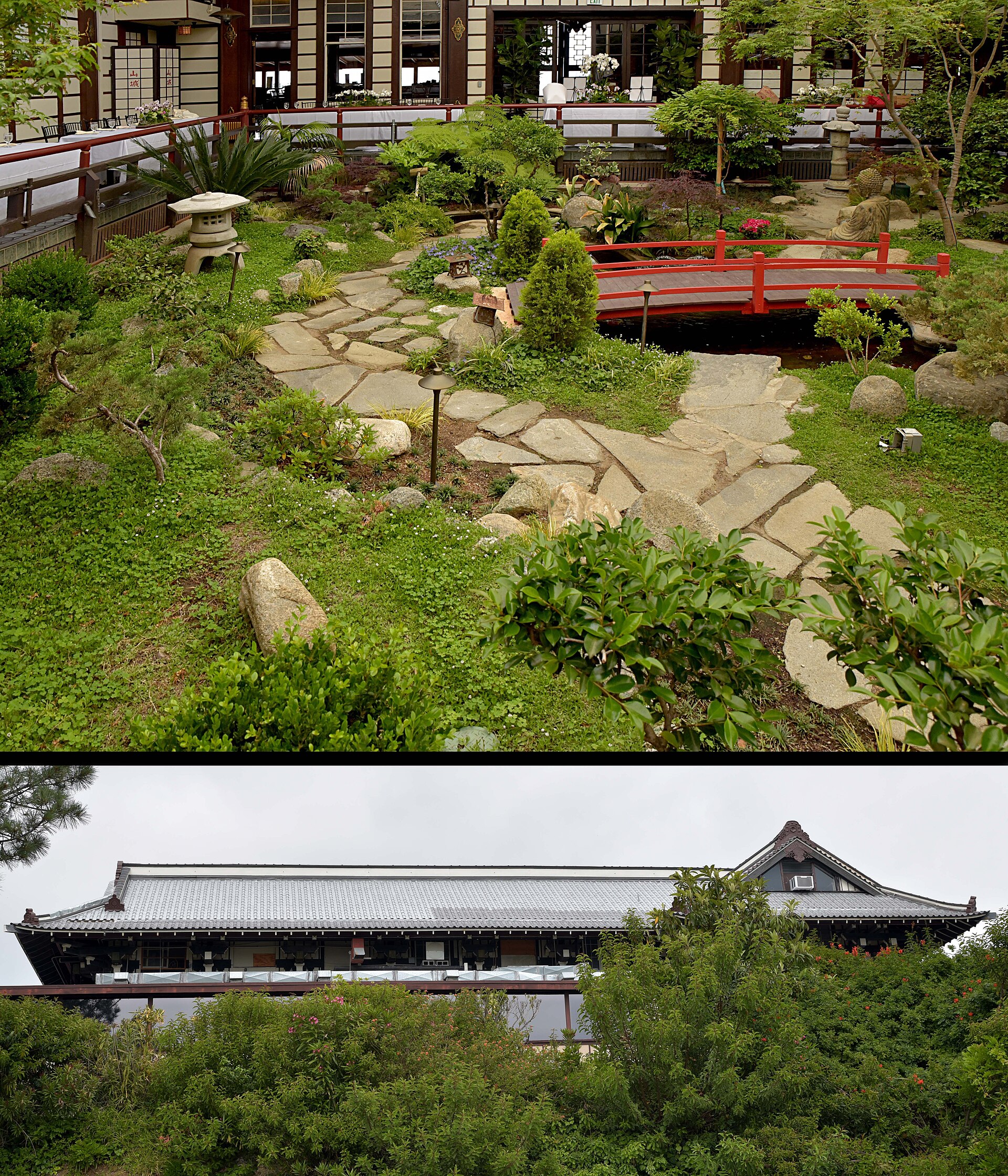
Thomas O. Glover bought Yamashiro in 1948 intending to replace it with a hotel and apartments. Then he began uncovering the building he planned to demolish.
Beneath the coverings were carved wood and silk. His son Tom described that discovery to the Beverly Press in 2015: his father changed his mind and began restoring the place.
What had been hidden
The mansion was completed in 1914 for Adolph and Eugene Bernheimer, collectors of Asian art. Its central courtyard and elaborate interiors belonged to a private estate above Hollywood.
It was an American-built interpretation of Asian architecture, not an ancient Japanese palace transported to California.
During World War II, anti-Japanese hostility brought vandalism and accusations that the estate was a signaling station. Decorative features were covered. The building later held fifteen apartments.
Glover’s discovery meant those concealed rooms could become something other than rubble. Keeping them was one decision. Finding a use for them was the next.
A restaurant, one room at a time
According to his son’s account, Glover won a liquor license in a city lottery. Faced with losing it if it went unused, he opened a bar in a back apartment. The building’s handyman served drinks.
The younger Glover later began serving food while helping his father one New Year’s Eve. A small operation gradually expanded through the building. PBS SoCal’s history describes a restaurant that began with four tables.
No grand dining room appeared overnight. The last apartment remained occupied until the mid-1980s, according to the Beverly Press report.
The Glover family’s ownership ended in 2016, when the property was sold. The restaurant continued under new operators.
The connection to another Hollywood institution runs down the hill: the Glover family also owned the building that became the Magic Castle.
See what survived
Yamashiro is at 1999 North Sycamore Avenue. Its official site currently lists dinner from 5–11 p.m. daily and links to reservations. Check before visiting.
The view is the famous part. The rooms you eat in are the part somebody nearly tore down.
How we reported this · 16 sources
- Press coverage: en.wikipedia.org
- Press coverage: en.wikipedia.org
- Press coverage: last1onthebus.com
- The venue's website: yamashirohollywood.com
- The venue's website: yamashirohollywood.com
- The venue's website: yamashirohollywood.com
- The venue's website: yamashirohollywood.com
- The venue's website: yamashirohollywood.com
- The venue's website: yamashirohollywood.com
- The venue's website: yamashirohollywood.com
- The venue's website: yamashirohollywood.com
- Press coverage: blogs.chapman.edu
- Press coverage: beverlypress.com
- Press coverage: pbssocal.org
- Press coverage: latimes.com
- The venue's website: yamashirohollywood.com
Pull a thread
Where this story goes next
Milt Larsen and his collaborators turned a neglected Hollywood house into the Magic Castle, giving salvaged pieces of the city another performance.
The Magic Castle · Hollywood, Los Angeles
A magic clubhouse built from things others discarded
Milt Larsen and his collaborators turned a neglected Hollywood house into the Magic Castle, giving salvaged pieces of the city another performance.
Read the storyHollywood began as a town that voted to ban liquor sales. Six years later it joined Los Angeles, for the water.
Place
Hollywood
A town that voted itself dry
Harvey Wilcox filed the name Hollywood with the county recorder in 1887; his wife, Daeida, said she chose it because it sounded nice and holly brings good luck. Hollywood incorporated as its own city in November 1903, by a vote of 88 to 77. Two months later its voters banned liquor sales except for medicine, 113 to 96, so its hotels and restaurants couldn't serve so much as a glass of wine with dinner. The independence didn't last. Hollywood merged with Los Angeles in February 1910 to get a reliable water supply and the city's sewers, and most of Prospect Avenue became Hollywood Boulevard.
Older than the sign
Frank's Cafe, the restaurant that became Musso & Frank, opened on Hollywood Boulevard on September 27, 1919, less than four months before national Prohibition began; one centennial history says the boulevard was still a dirt road. The HOLLYWOODLAND sign went up in the hills in 1923 to sell a housing development, and lost its last four letters in 1949. NPR, marking Musso's centennial, noted the restaurant is older than the sign. The Walk of Fame officially opened in 1960; in 2019 Musso & Frank got a star on it (Wikipedia calls it the first restaurant to receive one).
The writers' block
In the 1930s the studios brought the country's novelists to Hollywood, and the Screen Writers Guild kept offices across the boulevard from Musso & Frank. Stanley Rose's bookshop sat next door to the restaurant, and Alta reported that its owner held literature seminars in a space that housed slot machines. The novelists, as Mark Echeverria tells it, complained at the Guild and then crossed the street to drink at Musso's.
Now · Musso & Frank is still at 6667 Hollywood Boulevard, run by the family of John Mosso, who bought into it in 1927. Its website lists dinner Tuesday to Sunday.
- Musso & Frank Grill Hollywood's oldest restaurant, on the boulevard since 1919
- The Back Room at Musso & Frank Where the studios' novelists drank 1934-1955
- Frolic Room A 1930s bar on the boulevard, next door to the Pantages
- Charles Bukowski Drank on the boulevard, at Musso's among other bars
- The Magic Castle The magicians' clubhouse in a 1909 Hollywood mansion
- Avalon Hollywood The 1927 theater on Vine that became a nightclub
- Roscoe's House of Chicken 'N Waffles Chicken and waffles on Gower