
Frolic Room · Hollywood, Los Angeles
Why Hollywood’s famous faces are behind glass at this bar
The Frolic Room’s wall is printed Al Hirschfeld artwork. Keeping that familiar crowd in the room has taken restoration—and protection from the real crowd.
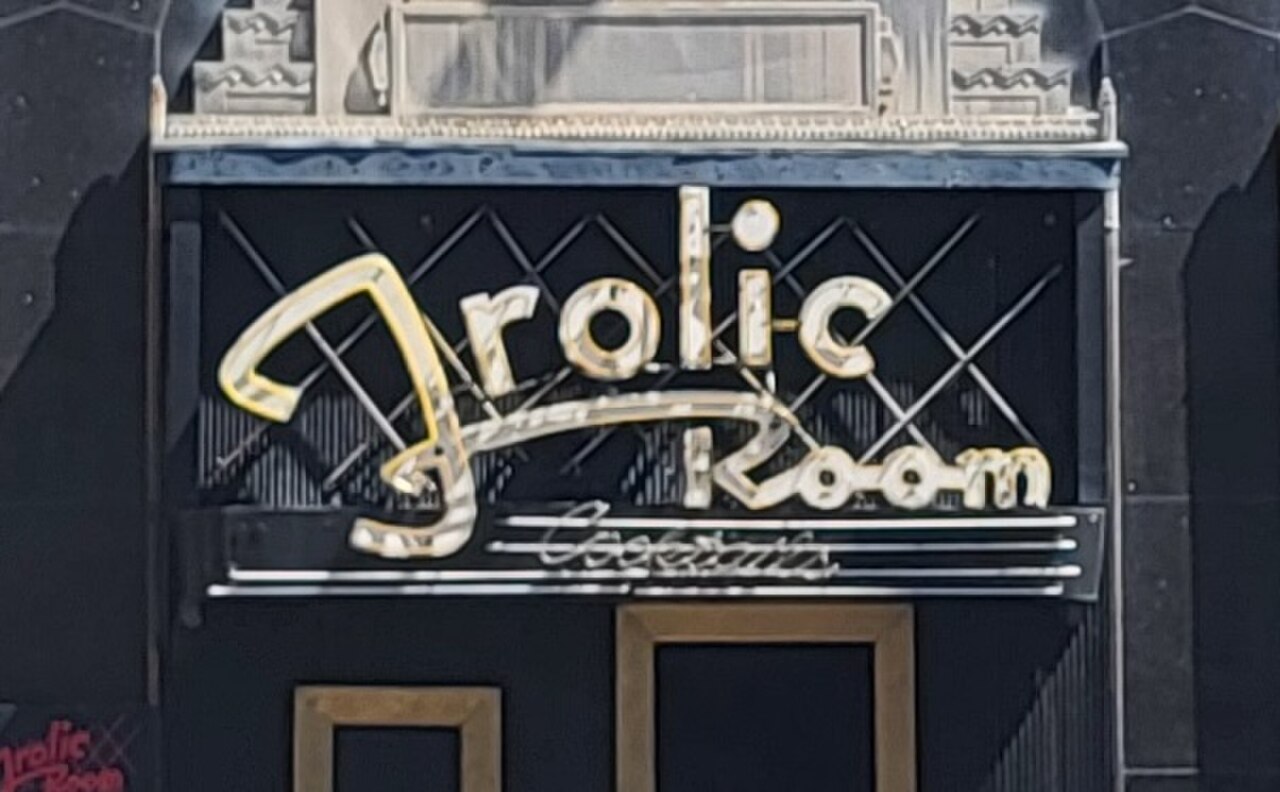
The Frolic Room has a crowd that never leaves: famous faces drawn across the wall, watched over by a pane of glass.
The glass is there because a working bar can be a rough place for a picture.
Owner Robert Nunley commissioned two restorations, adding glass after customers damaged the first, the Washington Post reported in 2017.
A drawing made to travel
Look closely and the faces resolve into performers: Louis Armstrong, Marilyn Monroe, Charlie Chaplin and others. Al Hirschfeld, the artist behind them, became known for capturing people with flowing lines. A caricature exaggerates a recognizable feature rather than reproducing every detail.
This wall is printed wallpaper, not a unique mural Hirschfeld drew in the bar. His foundation catalogs the design as a 1958 work published by James Seeman. Prints let the same gathering of faces travel into different rooms.
That makes its survival at the Frolic Room a story about care as much as art.
The people keeping the wall
Published accounts credit artist Oscar Rospide with restoration work in 2012. Bartender Tarek Martin later explained to the Hollywood Partnership that the glass over the lower section stopped people writing on and marking it.
The artwork could remain part of the room’s daily life without being within everyone’s reach. Visitors could still pick out a face, follow a line and argue over who they recognized.
Next door is the Hollywood Pantages, which hosted the Academy Awards in the 1950s. The bar’s place beside a theater gives those drawn performers an especially fitting home.
Find the familiar faces
The Frolic Room is at 6245 Hollywood Boulevard. The Hollywood Partnership directory lists daily hours of 11 a.m.–2 a.m.; confirm directly before visiting.
You can come for a drink and leave knowing the wall was something people chose to keep.
How we reported this · 27 sources
- The venue's website: frolicroomla.com
- The venue's website: frolicroomla.com
- Press coverage: hollywoodpartnership.com
- Press coverage: hollywoodpartnership.com
- Press coverage: smithsonianmag.com
- Press coverage: timeout.com
- Press coverage: scoundrelsfieldguide.com
- Press coverage: discoverlosangeles.com
- Press coverage: discoverlosangeles.com
- Press coverage: alhirschfeldfoundation.org
- Press coverage: alhirschfeldfoundation.org
- Press coverage: scenicwallpaper.com
- Press coverage: observer.com
- Press coverage: openlettersreview.com
- Press coverage: academymuseum.org
- Press coverage: en.wikipedia.org
- Press coverage: en.wikipedia.org
- Press coverage: en.wikipedia.org
- Press coverage: en.wikipedia.org
- Press coverage: en.wikipedia.org
- Press coverage: filmoblivion.com
- Press coverage: atomicredhead.com
- Press coverage: bucketlistbars.com
- Press coverage
- Press coverage: washingtonpost.com
- Press coverage: panoramaonview.org
- Press coverage: researchgate.net
Pull a thread
Where this story goes next
He sorted mail for over a decade, quit at 49 to write full time, and later renamed Werner Herzog "Wenner Zergog" in a novel.
Person
Charles Bukowski
Andernach to Mid-City
He was born Heinrich Karl Bukowski in Andernach, Germany, on August 16, 1920. His family sailed for Baltimore in 1923 and moved to Mid-City, Los Angeles, in 1930. He finished high school in 1939 and spent two years at Los Angeles City College before quitting at the start of the Second World War.
He decided to starve
In the early 1950s he worked as a fill-in letter carrier, and by 1960 he was back at the Los Angeles post office as a filing clerk, a job he held for more than a decade; Discover Los Angeles places him at the Terminal Annex on Alameda Street. In 1969, at 49, he took the publisher John Martin's offer and quit to write full time. He later wrote that he had "decided to starve." He finished the novel Post Office less than a month after leaving, and it came out in 1971.
Bukowski Court
In the 1960s and 1970s he lived in a run of apartments in what is now Thai Town. The best known is 5124 De Longpre Avenue, which Discover Los Angeles says he rented for $29 a month and where he wrote Post Office and Factotum. When it was threatened with demolition in 2007, fans saved it, and the city named it Historic-Cultural Monument 912, Bukowski Court. Nearby, Pink Elephant Liquors on Western Avenue delivered, which let him skip the drive and keep writing; its mid-century neon sign is still up.
Hollywood, renamed
He wrote the screenplay for Barfly (1987), with Mickey Rourke playing his alter ego, Henry Chinaski, opposite Faye Dunaway. Then he wrote a novel about making it, Hollywood (1989), with everyone renamed: Sean Penn became Tom Pell, Francis Ford Coppola became Frances Ford Lopalla, and Werner Herzog became Wenner Zergog. By then, Discover Los Angeles says, there was money for Musso & Frank, where he entertained Penn and Dennis Hopper, and for Hollywood's older bars, including the Frolic Room beside the Pantages.
Over the register
The Frolic Room "proudly proclaims its Buk association," Discover Los Angeles wrote in 2026. A framed photo of him hangs over the register, Scoundrel's Field Guide reports, and the Hollywood Partnership reported in 2017 that the bar once held weekly readings of his work. Time magazine called him a "laureate of American lowlife." He died in San Pedro on March 9, 1994, at 73, and his gravestone at Green Hills Memorial Park reads "Don't Try."
Now · As of August 2026, Discover Los Angeles found the Frolic Room still proclaiming its Bukowski connection, with his photo reportedly over the register, and Bukowski Court still standing on De Longpre Avenue as a city Historic-Cultural Monument.
- Musso & Frank Grill Where he entertained Sean Penn and Dennis Hopper 1980s
- Ruben Rueda The Musso & Frank waiter who drove him home
- Hollywood The town he put in a novel, under another name
At Musso & Frank, continuity depends on people making small, deliberate choices—again and again.
Musso & Frank Grill · Hollywood, Los Angeles
Musso & Frank names its pancake cook on the menu
At Musso & Frank, continuity depends on people making small, deliberate choices—again and again.
Read the storyHollywood began as a town that voted to ban liquor sales. Six years later it joined Los Angeles, for the water.
Place
Hollywood
A town that voted itself dry
Harvey Wilcox filed the name Hollywood with the county recorder in 1887; his wife, Daeida, said she chose it because it sounded nice and holly brings good luck. Hollywood incorporated as its own city in November 1903, by a vote of 88 to 77. Two months later its voters banned liquor sales except for medicine, 113 to 96, so its hotels and restaurants couldn't serve so much as a glass of wine with dinner. The independence didn't last. Hollywood merged with Los Angeles in February 1910 to get a reliable water supply and the city's sewers, and most of Prospect Avenue became Hollywood Boulevard.
Older than the sign
Frank's Cafe, the restaurant that became Musso & Frank, opened on Hollywood Boulevard on September 27, 1919, less than four months before national Prohibition began; one centennial history says the boulevard was still a dirt road. The HOLLYWOODLAND sign went up in the hills in 1923 to sell a housing development, and lost its last four letters in 1949. NPR, marking Musso's centennial, noted the restaurant is older than the sign. The Walk of Fame officially opened in 1960; in 2019 Musso & Frank got a star on it (Wikipedia calls it the first restaurant to receive one).
The writers' block
In the 1930s the studios brought the country's novelists to Hollywood, and the Screen Writers Guild kept offices across the boulevard from Musso & Frank. Stanley Rose's bookshop sat next door to the restaurant, and Alta reported that its owner held literature seminars in a space that housed slot machines. The novelists, as Mark Echeverria tells it, complained at the Guild and then crossed the street to drink at Musso's.
Now · Musso & Frank is still at 6667 Hollywood Boulevard, run by the family of John Mosso, who bought into it in 1927. Its website lists dinner Tuesday to Sunday.
- Musso & Frank Grill Hollywood's oldest restaurant, on the boulevard since 1919
- The Back Room at Musso & Frank Where the studios' novelists drank 1934-1955
- Charles Bukowski Drank on the boulevard, at Musso's among other bars
- The Magic Castle The magicians' clubhouse in a 1909 Hollywood mansion
- Avalon Hollywood The 1927 theater on Vine that became a nightclub
- Roscoe's House of Chicken 'N Waffles Chicken and waffles on Gower
- Yamashiro The 1914 replica of a Japanese palace in the hills above