
Musso & Frank Grill · Hollywood, Los Angeles
Musso & Frank names its pancake cook on the menu
At Musso & Frank, continuity depends on people making small, deliberate choices—again and again.
Musso & Frank’s menu names the cook behind its flannel cakes: Domingo Pule.
The thin cakes sit somewhere between a crêpe and a pancake. They have been served at the Hollywood restaurant for generations, and the menu credits Pule with keeping the original recipe alive.
The recipe needs a cook
Musso & Frank opened in 1919. Chef Jean Rue helped establish a menu that included dishes generations of customers would come back to order.
The flannel cakes date to Rue’s early years in the kitchen.
Other dishes carry similarly long histories. Welsh rarebit, despite its name, is a cheese dish served over toast. Chicken pot pie remains associated with Thursdays.
They even moved the old bar
The restaurant’s Back Room became a gathering place for writers working in Hollywood. When that room’s lease ended, the bar did not disappear.
In 1955, the family moved the bar, furniture and fixtures into another dining room. People still call it the New Room.
Find the place
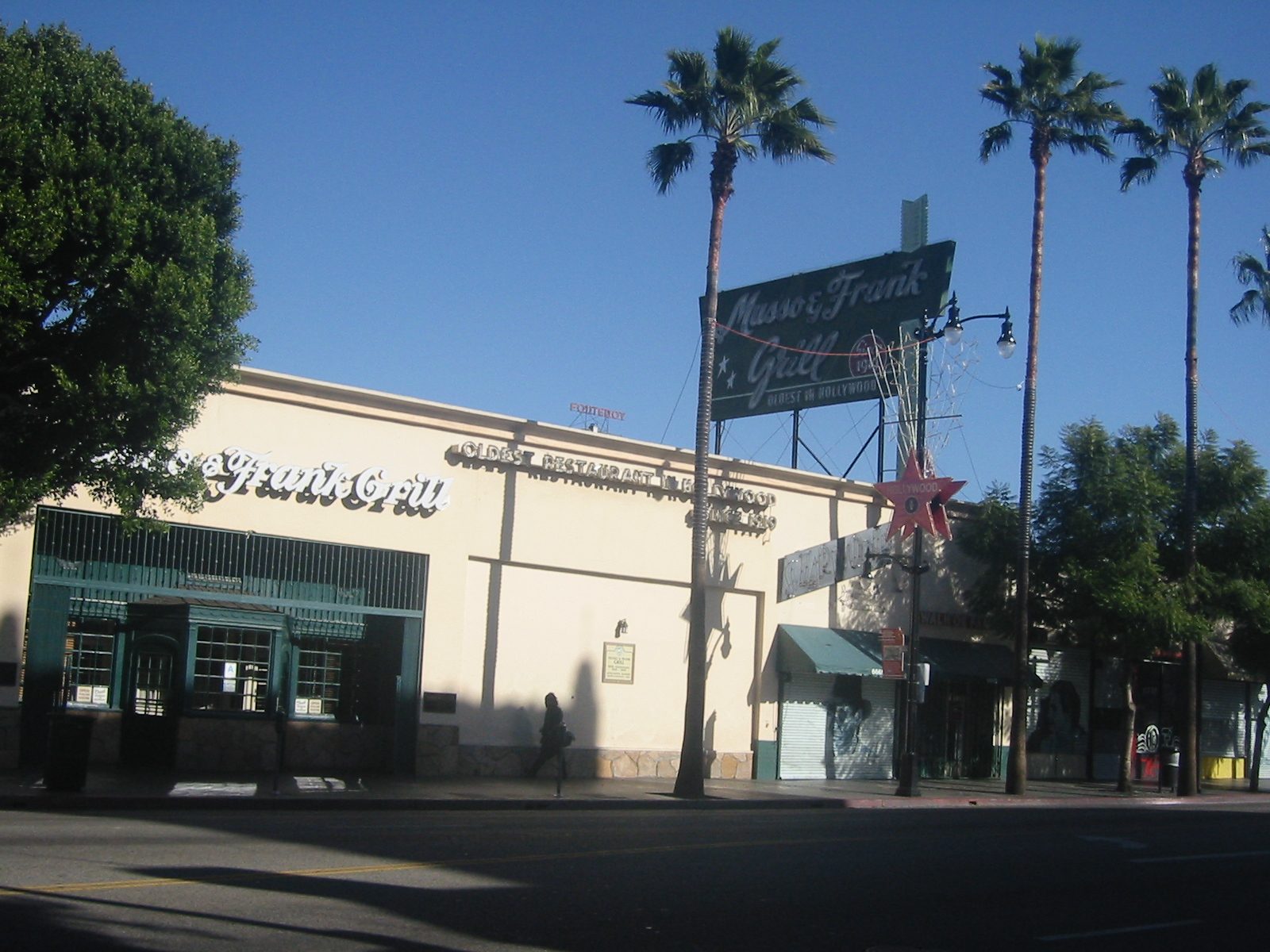
Musso & Frank is at 6667 Hollywood Boulevard. Use its official reservation page and menu for service times, daily specials and current availability.
How we reported this · 25 sources
- The venue's website: mussoandfrank.com
- The venue's website: mussoandfrank.com
- The venue's website: mussoandfrank.com
- The venue's website: mussoandfrank.com
- The venue's website: mussoandfrank.com
- The venue's website: mussoandfrank.com
- The venue's website: mussoandfrank.com
- The venue's website: mussoandfrank.com
- Press coverage: lamag.com
- Press coverage: tpr.org
- Press coverage: altaonline.com
- Press coverage: discoverlosangeles.com
- Press coverage: discoverhollywood.com
- Press coverage: magazinec.com
- Press coverage: afar.com
- Press coverage: insidehook.com
- Press coverage: laist.com
- Press coverage: ktla.com
- Press coverage: cbsnews.com
- Press coverage: abc7.com
- Press coverage: nbclosangeles.com
- Press coverage: laconservancy.org
- Press coverage: kevinegperry.com
- Press coverage: en.wikipedia.org
- Press coverage: en.wikipedia.org
Pull a thread
Where this story goes next
He cooked Mary Pickford's fettuccine for years and never put it on the menu. His flannel cakes are still on it.
Person
Jean Rue
Fifty-three years
Frank Toulet and Joseph Musso hired Rue in the early 1920s; sources put it at 1922 or 1923. He ran the kitchen for 53 years, and much of his menu is still served. In more than a century the restaurant has had three executive chefs.
Flannel cakes
The menu says flannel cakes have been on it since Rue started shaping Musso's food in the early 1920s, and describes them as a cross between a French crepe and a pancake, sweet and a little nutty. They come stacked with clarified butter and syrup or rolled with fruit and yogurt creme. Chef Domingo Pule, the menu says, has made them for more than 30 years and keeps the original recipe.
The golden fork
By the menu's account, Douglas Fairbanks and Mary Pickford tasted Alfredo's fettuccine on their honeymoon in Rome and begged for the recipe. Alfredo said no. The next night they gave him a golden fork and spoon, and he gave them the recipe. Back in Hollywood they asked Rue to make it, and he often did, specially for them, but never added it to the menu. Musso's now serves it as The Original Fettuccine Alfredo.
Now · The 2026 menu still carries flannel cakes three ways, Rue's Grenadine of Beef, and The Original Fettuccine Alfredo at $30.
The full story of Jean RueHe sorted mail for over a decade, quit at 49 to write full time, and later renamed Werner Herzog "Wenner Zergog" in a novel.
Person
Charles Bukowski
Andernach to Mid-City
He was born Heinrich Karl Bukowski in Andernach, Germany, on August 16, 1920. His family sailed for Baltimore in 1923 and moved to Mid-City, Los Angeles, in 1930. He finished high school in 1939 and spent two years at Los Angeles City College before quitting at the start of the Second World War.
He decided to starve
In the early 1950s he worked as a fill-in letter carrier, and by 1960 he was back at the Los Angeles post office as a filing clerk, a job he held for more than a decade; Discover Los Angeles places him at the Terminal Annex on Alameda Street. In 1969, at 49, he took the publisher John Martin's offer and quit to write full time. He later wrote that he had "decided to starve." He finished the novel Post Office less than a month after leaving, and it came out in 1971.
Bukowski Court
In the 1960s and 1970s he lived in a run of apartments in what is now Thai Town. The best known is 5124 De Longpre Avenue, which Discover Los Angeles says he rented for $29 a month and where he wrote Post Office and Factotum. When it was threatened with demolition in 2007, fans saved it, and the city named it Historic-Cultural Monument 912, Bukowski Court. Nearby, Pink Elephant Liquors on Western Avenue delivered, which let him skip the drive and keep writing; its mid-century neon sign is still up.
Hollywood, renamed
He wrote the screenplay for Barfly (1987), with Mickey Rourke playing his alter ego, Henry Chinaski, opposite Faye Dunaway. Then he wrote a novel about making it, Hollywood (1989), with everyone renamed: Sean Penn became Tom Pell, Francis Ford Coppola became Frances Ford Lopalla, and Werner Herzog became Wenner Zergog. By then, Discover Los Angeles says, there was money for Musso & Frank, where he entertained Penn and Dennis Hopper, and for Hollywood's older bars, including the Frolic Room beside the Pantages.
Over the register
The Frolic Room "proudly proclaims its Buk association," Discover Los Angeles wrote in 2026. A framed photo of him hangs over the register, Scoundrel's Field Guide reports, and the Hollywood Partnership reported in 2017 that the bar once held weekly readings of his work. Time magazine called him a "laureate of American lowlife." He died in San Pedro on March 9, 1994, at 73, and his gravestone at Green Hills Memorial Park reads "Don't Try."
Now · As of August 2026, Discover Los Angeles found the Frolic Room still proclaiming its Bukowski connection, with his photo reportedly over the register, and Bukowski Court still standing on De Longpre Avenue as a city Historic-Cultural Monument.
- Frolic Room A regular; his photo hangs over the register
- Ruben Rueda The Musso & Frank waiter who drove him home
- Hollywood The town he put in a novel, under another name
The Frolic Room’s wall is printed Al Hirschfeld artwork. Keeping that familiar crowd in the room has taken restoration—and protection from the real crowd.
Frolic Room · Hollywood, Los Angeles
Why Hollywood’s famous faces are behind glass at this bar
The Frolic Room’s wall is printed Al Hirschfeld artwork. Keeping that familiar crowd in the room has taken restoration—and protection from the real crowd.
Read the storyHollywood began as a town that voted to ban liquor sales. Six years later it joined Los Angeles, for the water.
Place
Hollywood
A town that voted itself dry
Harvey Wilcox filed the name Hollywood with the county recorder in 1887; his wife, Daeida, said she chose it because it sounded nice and holly brings good luck. Hollywood incorporated as its own city in November 1903, by a vote of 88 to 77. Two months later its voters banned liquor sales except for medicine, 113 to 96, so its hotels and restaurants couldn't serve so much as a glass of wine with dinner. The independence didn't last. Hollywood merged with Los Angeles in February 1910 to get a reliable water supply and the city's sewers, and most of Prospect Avenue became Hollywood Boulevard.
Older than the sign
Frank's Cafe, the restaurant that became Musso & Frank, opened on Hollywood Boulevard on September 27, 1919, less than four months before national Prohibition began; one centennial history says the boulevard was still a dirt road. The HOLLYWOODLAND sign went up in the hills in 1923 to sell a housing development, and lost its last four letters in 1949. NPR, marking Musso's centennial, noted the restaurant is older than the sign. The Walk of Fame officially opened in 1960; in 2019 Musso & Frank got a star on it (Wikipedia calls it the first restaurant to receive one).
The writers' block
In the 1930s the studios brought the country's novelists to Hollywood, and the Screen Writers Guild kept offices across the boulevard from Musso & Frank. Stanley Rose's bookshop sat next door to the restaurant, and Alta reported that its owner held literature seminars in a space that housed slot machines. The novelists, as Mark Echeverria tells it, complained at the Guild and then crossed the street to drink at Musso's.
Now · Musso & Frank is still at 6667 Hollywood Boulevard, run by the family of John Mosso, who bought into it in 1927. Its website lists dinner Tuesday to Sunday.
- The Back Room at Musso & Frank Where the studios' novelists drank 1934-1955
- Frolic Room A 1930s bar on the boulevard, next door to the Pantages
- Charles Bukowski Drank on the boulevard, at Musso's among other bars
- The Magic Castle The magicians' clubhouse in a 1909 Hollywood mansion
- Avalon Hollywood The 1927 theater on Vine that became a nightclub
- Roscoe's House of Chicken 'N Waffles Chicken and waffles on Gower
- Yamashiro The 1914 replica of a Japanese palace in the hills above
4 more threads
It comes in a glass too small for the drink. The rest sits beside you on crushed ice, in a carafe called the sidecar.
Drink
The Musso & Frank martini
The service
Musso's April 2026 drinks list spells out the ritual: the martini is stirred and NEVER shaken, poured into a smaller cup, and the rest of the drink goes into a small glass decanter set in an ice bucket of crushed ice, so it stays at the right temperature. InsideHook and Discover Los Angeles both call that decanter the sidecar. In 2019 Andrea Scuto, then the general manager, told Los Angeles magazine the glass is small on purpose, "old-timey," that the drink is stirred about a dozen times, and that "James Bond had it all wrong."
The gin, and the vermouth question
In 2019 the house pour was Gilbey's, gin or vodka, with olives cured in-house, by Los Angeles magazine's account, which also said Musso's skips vermouth. AFAR, the same summer, described a splash of vermouth. Ask the bartender how you want it.
The count
AFAR, citing the Los Angeles Times, reported that Musso's served 55,272 martinis in 2018; C Magazine put it at about 53,000. Ruben Rueda, who tended the bar for about half a century, told LAist he aimed to make his martinis completely dry, almost, and that his homemade ones never tasted like the ones at Musso's.
Now · The April 2026 drinks list still describes the stirred martini and its iced decanter, and calls the bar notorious for classic cocktails.
- The Back Room at Musso & Frank The bar it was first poured at, by the house's telling
- Ruben Rueda Stirred it for about half a century 1967-2019
Musso's let one novelist behind the bar to muddle his own mint juleps. Was it Faulkner or Fitzgerald?
Settle it
Who mixed his own mint juleps behind Musso's bar?
One exception
The story goes that one writer was once allowed behind Musso's bar to make his own drinks. Which writer depends on who is telling it.
- The Back Room at Musso & Frank The room both men are said to have drunk in
He drove Charles Bukowski home more than once. One night Bukowski broke his windshield, and never paid.
Person
Ruben Rueda
Half a century at one station
Rueda came from Durango, Mexico, and walked into Musso's in 1967 looking for work as a server's assistant. After a few months bussing he moved behind the bar, and LAist found him at the same station 50 years later. He told LAist he liked talking to people more than pouring and leaving, and that he judged when to cut someone off by looking at their eyes.
His regulars
Keith Richards, whose usual was three shots of vodka and a shot of Campari, showed up with a signed guitar two years after Rueda asked him for one. Gore Vidal drank double Black Label Scotch; late in life, staff lifted him onto Rueda's barstool for one more visit. Rueda drove Charles Bukowski home many times, and one night, when Rueda braked, Bukowski's feet on the dashboard broke the windshield. Bukowski promised to pay. He never did.
- Charles Bukowski Drove him home, and lost a windshield
- The Musso & Frank martini Made it, he said, completely dry, almost
Behind a stern maitre d' sat the bar where Faulkner, Chandler and Dorothy Parker drank. The bar itself still pours, one room over.
Venue
The Back Room at Musso & Frank
The door
By the restaurant's account the Back Room opened in 1934 as a private space for the Hollywood elite, guarded by a "discerning and austere maitre d'." Its 2026 drinks list dates the opening to 1935 and calls the room small, intimate and exclusive; the same list says the bar has served classic cocktails since it opened in 1934, months after national Prohibition ended.
The roll call
The Screen Writers Guild was across the street and Stanley Rose's bookshop next door. The restaurant's own list of writers who came through reads like a syllabus: F. Scott Fitzgerald, who it says proofread novels in a booth; William Faulkner, who it says met Meta Carpenter there; Raymond Chandler, who it says wrote several chapters of The Big Sleep while drinking in the Back Room; plus Dorothy Parker, Dashiell Hammett, William Saroyan, Aldous Huxley, John Steinbeck and, later, Charles Bukowski. Carpenter, in her memoir, said Faulkner preferred Musso's for its comparatively reasonable prices. A waiter told Alta in 2023 that the screenwriters came to ease their frustration over edits.
The move
When the Back Room's lease ran out, the restaurant closed it, by its own account to the dismay of the Hollywood elite. In 1955 the bar, the light fixtures and the 1934 furniture moved into a dining room that is still called the New Room. In the 1950s, the Los Angeles Conservancy notes, Marilyn Monroe and Elizabeth Taylor were seen in the Back Room.
Now · The Back Room's bar, light fixtures and 1934 furniture are in use in the New Room, and the April 2026 drinks list still tells the room's story.
- Who mixed his own mint juleps behind Musso's bar? Who got to mix his own drinks behind its bar
- Hollywood Across the boulevard from the Screen Writers Guild
- Charles Bukowski One of the writers on the restaurant's roll call
- Frolic Room Another Hollywood Boulevard bar from the 1930s