
The Magic Castle · Hollywood, Los Angeles
A magic clubhouse built from things others discarded
Milt Larsen and his collaborators turned a neglected Hollywood house into the Magic Castle, giving salvaged pieces of the city another performance.
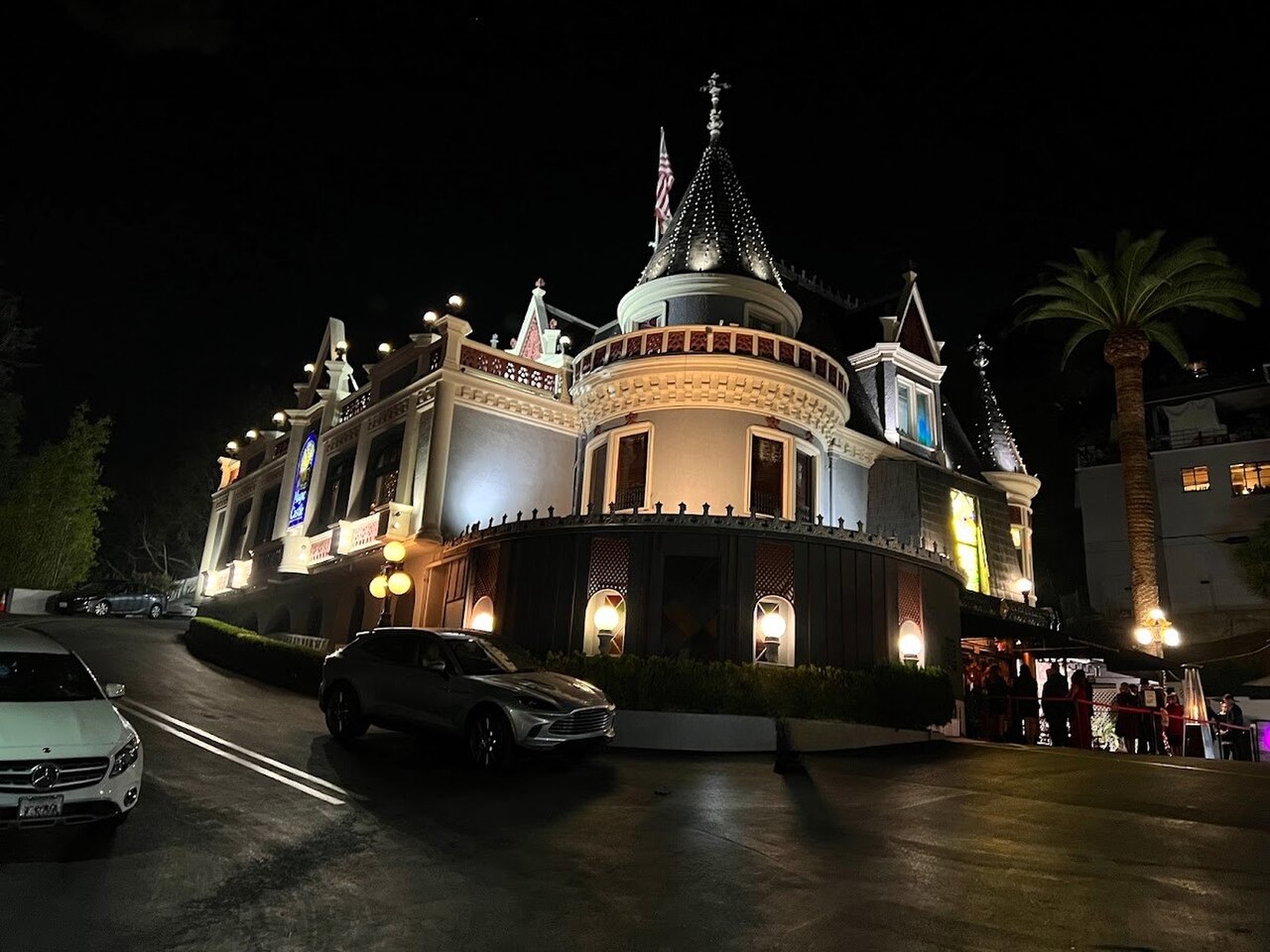
To build the Magic Castle, Milt Larsen collected things Los Angeles was throwing away. An old gym floor became the bar top. Stained glass, banisters and chandeliers found new uses inside his magicians’ clubhouse.
An idea needs a building
Larsen came from a family of magicians. His father, William Larsen Sr., had announced an Academy of Magical Arts in 1952 but died before it had a permanent home.
Milt spotted a deteriorating mansion from his office window.
With his brother Bill, Bill’s wife Irene and collaborators including Don Gotschall, he helped turn it into a place where the academy could gather and perform.
The Castle opened in January 1963.
Give the audience something to discover
The salvaged pieces helped create an interior full of surprises.
A bookcase opens into the club. The house presents a piano-playing ghost called Irma. Different rooms bring audiences close to different kinds of magic.
These are performances and theatrical devices, part of the pleasure of entering a place designed by people who understand misdirection.
Behind the atmosphere is a working community: performers, staff and people studying a craft. The academy’s library connects them with earlier generations of magicians.
The building itself follows the same principle as a good illusion. Familiar things are placed in a new arrangement, and suddenly you look at them differently.
Find the place
The Magic Castle is at 7001 Franklin Avenue. It is a private club with specific guest-access, reservation, dress and age rules. Read its official visitor guidance before making plans.
How we reported this · 12 sources
- The venue's website: magiccastle.com
- The venue's website: magiccastle.com
- The venue's website: magiccastle.com
- The venue's website: magiccastle.com
- Press coverage: lamag.com
- Press coverage: lamag.com
- Press coverage: lamag.com
- Press coverage: lamag.com
- Press coverage: theeastsiderla.com
- Press coverage: en.wikipedia.org
- The venue's website: magiccastle.com
- The venue's website: magiccastle.com
Pull a thread
Where this story goes next
Hollywood began as a town that voted to ban liquor sales. Six years later it joined Los Angeles, for the water.
Place
Hollywood
A town that voted itself dry
Harvey Wilcox filed the name Hollywood with the county recorder in 1887; his wife, Daeida, said she chose it because it sounded nice and holly brings good luck. Hollywood incorporated as its own city in November 1903, by a vote of 88 to 77. Two months later its voters banned liquor sales except for medicine, 113 to 96, so its hotels and restaurants couldn't serve so much as a glass of wine with dinner. The independence didn't last. Hollywood merged with Los Angeles in February 1910 to get a reliable water supply and the city's sewers, and most of Prospect Avenue became Hollywood Boulevard.
Older than the sign
Frank's Cafe, the restaurant that became Musso & Frank, opened on Hollywood Boulevard on September 27, 1919, less than four months before national Prohibition began; one centennial history says the boulevard was still a dirt road. The HOLLYWOODLAND sign went up in the hills in 1923 to sell a housing development, and lost its last four letters in 1949. NPR, marking Musso's centennial, noted the restaurant is older than the sign. The Walk of Fame officially opened in 1960; in 2019 Musso & Frank got a star on it (Wikipedia calls it the first restaurant to receive one).
The writers' block
In the 1930s the studios brought the country's novelists to Hollywood, and the Screen Writers Guild kept offices across the boulevard from Musso & Frank. Stanley Rose's bookshop sat next door to the restaurant, and Alta reported that its owner held literature seminars in a space that housed slot machines. The novelists, as Mark Echeverria tells it, complained at the Guild and then crossed the street to drink at Musso's.
Now · Musso & Frank is still at 6667 Hollywood Boulevard, run by the family of John Mosso, who bought into it in 1927. Its website lists dinner Tuesday to Sunday.
- Musso & Frank Grill Hollywood's oldest restaurant, on the boulevard since 1919
- The Back Room at Musso & Frank Where the studios' novelists drank 1934-1955
- Frolic Room A 1930s bar on the boulevard, next door to the Pantages
- Charles Bukowski Drank on the boulevard, at Musso's among other bars
- Avalon Hollywood The 1927 theater on Vine that became a nightclub
- Roscoe's House of Chicken 'N Waffles Chicken and waffles on Gower
- Yamashiro The 1914 replica of a Japanese palace in the hills above