
Roscoe's House of Chicken 'N Waffles · Hollywood, Los Angeles
Herb Hudson brought a Harlem plate to Los Angeles.
Chicken and waffles needed an introduction. Food, music and people telling their friends helped Roscoe’s make one.
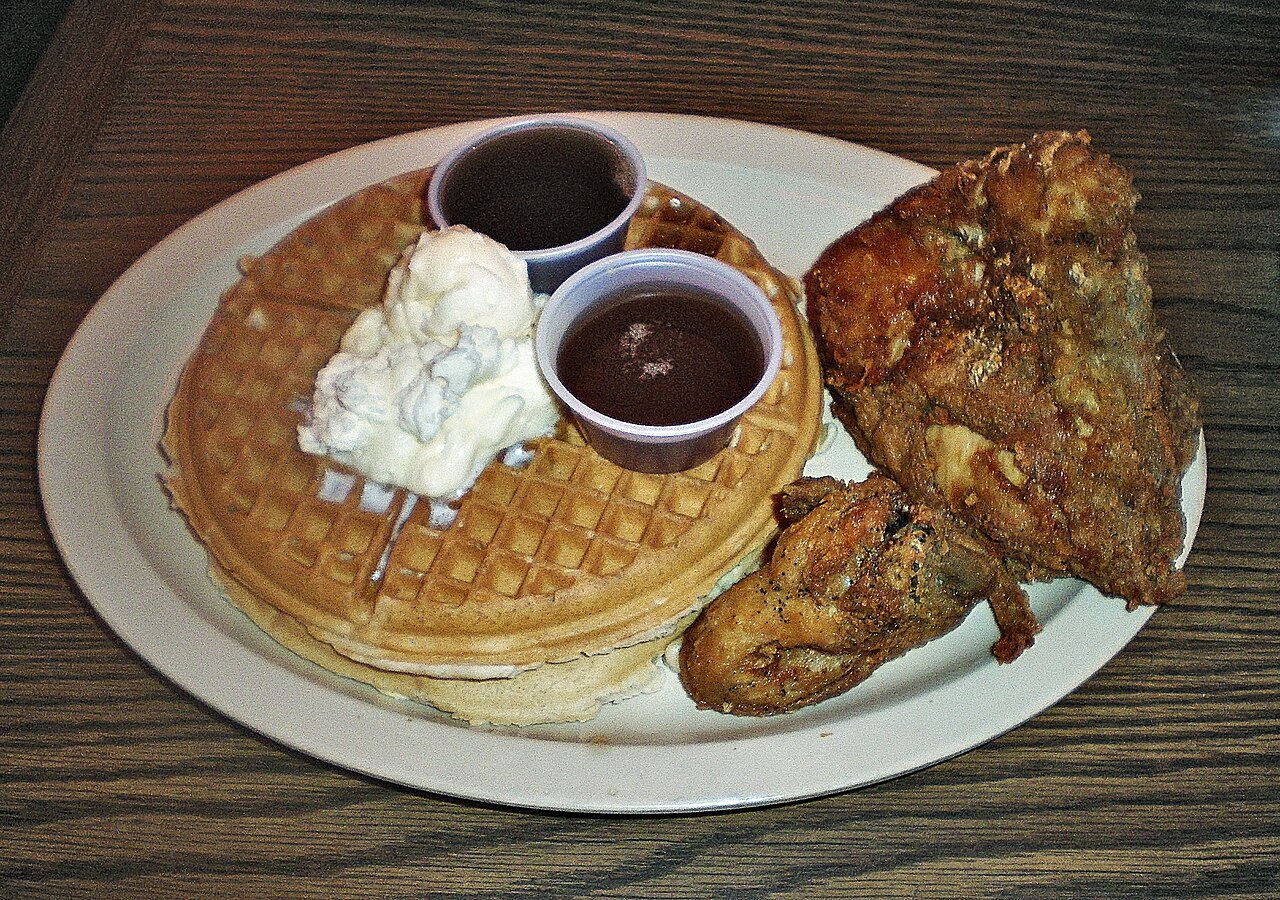
Herb Hudson brought a Harlem favorite to Southern California in 1975: fried chicken and waffles on the same plate.
Getting people to try Roscoe’s was part of the work. Some well-known friends helped spread the word.
Let people taste it
Hudson brought more than a recipe west. He knew people in the music business.
Roscoe’s own history describes Stevie Wonder and Natalie Cole telling friends about the restaurant. Redd Foxx mentioned it to audiences. Food and word of mouth traveled together.
A 1978 advertisement described an East Coast specialty in a West Coast setting. That was the invitation: something people elsewhere already loved, now available here.
The origin story travels too
Chicken and waffles has several histories.
Harlem’s Wells Supper Club became famous for serving it. The familiar explanation says musicians wanted a meal between dinner and breakfast. Food historian Adrian Miller cautions that this neat invention story leaves out earlier chicken-and-waffle traditions.
Roscoe’s own first address is also disputed: the company points to Hollywood, while other accounts put Long Beach first.
The clear part is the influence. Hudson helped make the combination a Southern California institution.
A menu becomes a memory
The restaurant’s named plates include Herb’s Special. Famous visits added more stories, including Barack Obama’s 2011 order on Pico Boulevard.
Find the place
The Hollywood Roscoe’s is at 1514 North Gower Street. Check the official directory for operating locations and individual hours. The Pasadena location is marked permanently closed; the old Pico restaurant is also no longer a dining destination.
How we reported this · 14 sources
- Press coverage: blog.resy.com
- Press coverage: melmagazine.com
- Press coverage: tmz.com
- Press coverage: chowhound.com
- Press coverage: complex.com
- Press coverage: foxla.com
- Press coverage: lamag.com
- Press coverage: en.wikipedia.org
- The venue's website: roscoeschickenandwaffles.com
- The venue's website: roscoeschickenandwaffles.com
- The venue's website: roscoeschickenandwaffles.com
- The venue's website: roscoeschickenandwaffles.com
- The venue's website: roscoeschickenandwaffles.com
- The venue's website: roscoeschickenandwaffles.com
Pull a thread
Where this story goes next
He started as a proofreader, interviewed Dr. Dre, and is buried under the words "Tacos Forever."
Person
Jonathan Gold
From proofreader to rap writer
Gold was born in Los Angeles on July 28, 1960. As a UCLA freshman he briefly worked at a kosher restaurant owned by Leah Adler, Steven Spielberg's mother. In 1982 he became a proofreader at LA Weekly, where he met his future wife, Laurie Ochoa, then moved to the music section, writing about classical music and hip-hop and interviewing Snoop Dogg, Dr. Dre and members of N.W.A.
The critic in the strip mall
He started Counter Intelligence in 1986, wrote for the Los Angeles Times from 1990 to 1996, went to New York for Gourmet in 1999 and came back in 2001. In 2007 he became the first food critic to win the Pulitzer Prize for Criticism, for his LA Weekly reviews, and in 2012 he became the Times' chief critic. Anthony Bourdain said he was the first to turn the focus from white tablecloths to "really cool little places in strip malls." LAist wrote that he saw the city as a mosaic, an "anti-melting pot."
No notebook at the table
He would not take notes at dinner: "Taking notes while you're eating is like taking notes while you're making love." LAist recalled him returning to one Taiwanese restaurant 16 or 17 times. "There are definitely moments when you're eating with me that I will be in a trance state," he said. Los Angeles Magazine wrote that he gave the same attention to trucks and stands as to fine dining.
Tacos Forever
Gold died of pancreatic cancer on July 21, 2018, at 57. On July 28, his birthday, buildings and landmarks across Los Angeles were lit in gold. The James Beard Foundation renamed its Local Impact Award the Jonathan Gold Local Voice Award, and in 2019 gave him a posthumous award. He is buried at Hollywood Forever Cemetery under the epitaph "Tacos Forever."
- Counter Intelligence His column and book 1986-2018
- Jitlada Championed Tui Sungkamee's Southern Thai cooking
- Guelaguetza A family restaurant he championed, per the James Beard Foundation
- King Taco #1 Called its tacos "solid B+ tacos" and said it may have set the modern LA taco sensibility 2013
Swingers cost $250,000, and more of that went to music rights than to making the movie.
Work
Swingers (1996)
Written in ten days, shot on leftovers
Jon Favreau told Grantland in 2014 that he started the script as an exercise after a breakup and wrote it in about a week and a half, roughly 10 pages a day. Doug Liman told Grantland he raised $200,000 from a business associate of his father's on the condition that he direct; Wikipedia lists the budget at $250,000. Per Wikipedia, much of it was shot on short ends, so many scenes ran about 60 seconds a take, and more money went to music licensing than to the film itself.
Real rooms, real customers
Liman's rule, as he told Grantland, was to shoot in a bar while it's open to the public, because it comes with all the extras. The Dresden in Los Feliz, a bar Wikipedia says Vince Vaughn frequently visited, plays itself. The Derby finale was shot while the club was open, with people paying admission on the floor, per the band's Scotty Morris. Mike's apartment was Favreau's own, in Franklin Village. Film Oblivion reports that the scene set behind the Dresden was really shot in Musso & Frank Grill's parking lot, dressed with Dresden signs. The Vegas footage, about 15 minutes of the film, was shot in one night, with, per Wikipedia, exteriors at the Stardust and interiors at the Fremont.
So money
Ron Livingston told Grantland that Favreau took "You're so money" from the Spike Lee and Michael Jordan commercials, in which Lee calls Jordan money. Wikipedia notes that "money" became general slang for approval after the film, and "Vegas, baby!" stuck to the city.
A slow fuse
Miramax bought the film, for $5 million (Liman recalls $5.5 million in Wikipedia's account). It premiered at the Vista Theatre in Los Feliz; Wikipedia lists a $4.6 million gross. Favreau told Grantland it was not a hit by any stretch; home video and an MTV award for Liman made it a cult film, and it launched Favreau, Vaughn, Heather Graham and Ron Livingston. In 2008 Los Angeles Times writers and editors voted it the 14th best film set in LA of the previous 25 years.
Now · The film turns 30 on October 18, 2026. Of its LA rooms, the Dresden and Musso & Frank are open and the Vista is screening again; the Derby closed in 2009 and the coffee shop in the pandemic years.
- The Derby Where the swing-dancing finale was shot 1996
- The Dresden Mike gets the number here 1996
- Musso & Frank Grill Its parking lot stood in for the back of the Dresden, per Film Oblivion 1996
- Los Feliz Two of its bars are here 1996
Hollywood began as a town that voted to ban liquor sales. Six years later it joined Los Angeles, for the water.
Place
Hollywood
A town that voted itself dry
Harvey Wilcox filed the name Hollywood with the county recorder in 1887; his wife, Daeida, said she chose it because it sounded nice and holly brings good luck. Hollywood incorporated as its own city in November 1903, by a vote of 88 to 77. Two months later its voters banned liquor sales except for medicine, 113 to 96, so its hotels and restaurants couldn't serve so much as a glass of wine with dinner. The independence didn't last. Hollywood merged with Los Angeles in February 1910 to get a reliable water supply and the city's sewers, and most of Prospect Avenue became Hollywood Boulevard.
Older than the sign
Frank's Cafe, the restaurant that became Musso & Frank, opened on Hollywood Boulevard on September 27, 1919, less than four months before national Prohibition began; one centennial history says the boulevard was still a dirt road. The HOLLYWOODLAND sign went up in the hills in 1923 to sell a housing development, and lost its last four letters in 1949. NPR, marking Musso's centennial, noted the restaurant is older than the sign. The Walk of Fame officially opened in 1960; in 2019 Musso & Frank got a star on it (Wikipedia calls it the first restaurant to receive one).
The writers' block
In the 1930s the studios brought the country's novelists to Hollywood, and the Screen Writers Guild kept offices across the boulevard from Musso & Frank. Stanley Rose's bookshop sat next door to the restaurant, and Alta reported that its owner held literature seminars in a space that housed slot machines. The novelists, as Mark Echeverria tells it, complained at the Guild and then crossed the street to drink at Musso's.
Now · Musso & Frank is still at 6667 Hollywood Boulevard, run by the family of John Mosso, who bought into it in 1927. Its website lists dinner Tuesday to Sunday.
- Musso & Frank Grill Hollywood's oldest restaurant, on the boulevard since 1919
- The Back Room at Musso & Frank Where the studios' novelists drank 1934-1955
- Frolic Room A 1930s bar on the boulevard, next door to the Pantages
- Charles Bukowski Drank on the boulevard, at Musso's among other bars
- The Magic Castle The magicians' clubhouse in a 1909 Hollywood mansion
- Avalon Hollywood The 1927 theater on Vine that became a nightclub
- Yamashiro The 1914 replica of a Japanese palace in the hills above
One Long Beach neighborhood is named for a railway stop, and nobody agrees how to spell it.
Place
Long Beach
A stop called Zaferia
East Long Beach's Zaferia grew up around a stop at the Redondo crossing on the Pacific Electric's Balboa route; a 1919 Long Beach Telegram story said the railway gave the stop its name. The area was annexed by Long Beach in 1920, The Long Beach library says nobody knows the correct spelling or pronunciation, which is why Zafaria and Zefaria turn up too.
Anaheim Street since 1924
In 1924 the barber Joe Jost moved his business from the Balboa Peninsula to Anaheim Street, a barbershop with pool and poker that became a tavern after repeal. The Long Beach Post called it the city's oldest bar when it turned 100 in August 2024, and Councilmember Cindy Allen called it "part of the fabric of our city."
Now · Joe Jost's is open every day from 10 a.m. to 10 p.m. at 2803 East Anaheim Street, by its 2026 website.
- Joe Jost's The barbershop that became a 100-year-old tavern since 1924
- Harvelle's Harvelle's second room is on Broadway in Long Beach
- Pacific Electric The Pacific Electric railway whose stop named Zaferia