
Guelaguetza · Koreatown, Los Angeles
Their parents wanted to sell Guelaguetza. They bought it.
Bricia Lopez and her siblings took on Guelaguetza with a written promise to pay their parents back—and a family’s food to carry forward.
Bricia Lopez had planned on a career in journalism or broadcasting. Then her parents considered selling Guelaguetza, the family’s Oaxacan restaurant in Los Angeles.
The recession had left them with debts. They wanted to sell and return to Mexico. Bricia and her siblings decided to buy the restaurant themselves.
A promise with monthly payments
Bricia told The Splendid Table that they used a promissory note: a written agreement to pay their parents in installments.
The takeover did not make the difficult days disappear. Sometimes no customers came in. The siblings worked out their roles and cut personal spending rather than compromise the food.
Their parents returned to Oaxaca, the southern Mexican state where the family’s food traditions began. The children’s payments helped support their retirement.
The food they were keeping
Their father, Fernando Lopez, had arrived in Los Angeles in 1993 and sold Oaxacan food products door to door before opening the restaurant in 1994.
Their mother, Maria Monterrubio, brought the family recipe for mole negro.
Mole negro is a dark sauce made with chiles and other toasted ingredients. At Guelaguetza, it came from Maria’s family recipe.
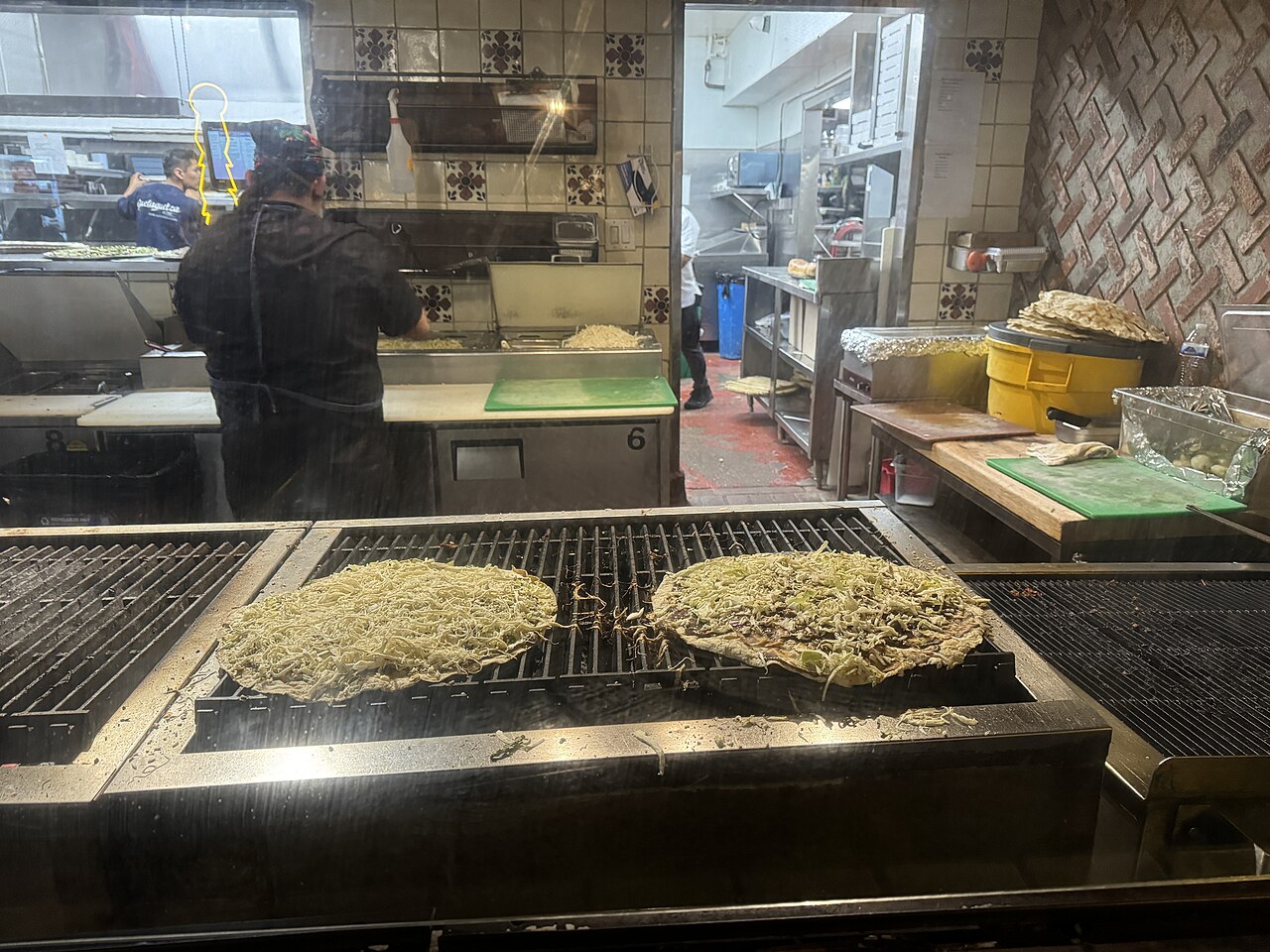
The restaurant also serves tlayudas: large corn tortillas grilled with toppings that can include beans, cheese and meat.
One community’s gathering place becomes another’s
The current building had been VIP Palace, a Korean restaurant and cultural gathering place. The Lopez family took it over in 2001 and kept its distinctive Korean exterior.
Inside, Oaxacan food, music and celebration gave the building another life.
Guelaguetza takes its name from Oaxacan traditions of giving and helping one another.
Find the place
Guelaguetza is at 3014 West Olympic Boulevard. Check its official menu and booking information for current dishes, hours and reservations.
How we reported this · 8 sources
- Press coverage: pbssocal.org
- Press coverage: pbssocal.org
- Press coverage: blog.resy.com
- Press coverage: splendidtable.org
- Press coverage: lamag.com
- Public record: laconservancy.org
- Press coverage
- The venue's website: ilovemole.com
Pull a thread
Where this story goes next
Los Angeles magazine ranked LA the third most important center of Oaxacan cooking on earth, after Oaxaca and Mexico City.
Movement
Oaxacalifornia
The first family
PBS SoCal said the Lopez family is often called Oaxacalifornia's first family. Besides Guelaguetza, which Fernando Lopez opened in 1994 after a year selling Oaxacan food products door to door, he founded El Oaxaqueno, a free newspaper. Los Angeles magazine, writing about the restaurant's 2015 James Beard award, said Guelaguetza is where Oaxacalifornia began and called Los Angeles the third most important center of Oaxacan cooking in the world.
Giving back
Bricia Lopez described guelaguetza to The Splendid Table as a Oaxacan tradition of reciprocity, of giving to one another. Critic Jonathan Gold called the restaurant "the best Oaxacan restaurant in the United States."
- Jonathan Gold Called Guelaguetza the best Oaxacan restaurant in the United States
- Koreatown Where LA's best-known Oaxacan restaurant opened since 1994
Philippe’s French-dip origin story is disputed. The decision that kept it alive in 1951 is a story worth telling.
Philippe the Original · Chinatown, Los Angeles
The freeway was coming. The family moved the restaurant.
Philippe’s French-dip origin story is disputed. The decision that kept it alive in 1951 is a story worth telling.
Read the storyHe started as a proofreader, interviewed Dr. Dre, and is buried under the words "Tacos Forever."
Person
Jonathan Gold
From proofreader to rap writer
Gold was born in Los Angeles on July 28, 1960. As a UCLA freshman he briefly worked at a kosher restaurant owned by Leah Adler, Steven Spielberg's mother. In 1982 he became a proofreader at LA Weekly, where he met his future wife, Laurie Ochoa, then moved to the music section, writing about classical music and hip-hop and interviewing Snoop Dogg, Dr. Dre and members of N.W.A.
The critic in the strip mall
He started Counter Intelligence in 1986, wrote for the Los Angeles Times from 1990 to 1996, went to New York for Gourmet in 1999 and came back in 2001. In 2007 he became the first food critic to win the Pulitzer Prize for Criticism, for his LA Weekly reviews, and in 2012 he became the Times' chief critic. Anthony Bourdain said he was the first to turn the focus from white tablecloths to "really cool little places in strip malls." LAist wrote that he saw the city as a mosaic, an "anti-melting pot."
No notebook at the table
He would not take notes at dinner: "Taking notes while you're eating is like taking notes while you're making love." LAist recalled him returning to one Taiwanese restaurant 16 or 17 times. "There are definitely moments when you're eating with me that I will be in a trance state," he said. Los Angeles Magazine wrote that he gave the same attention to trucks and stands as to fine dining.
Tacos Forever
Gold died of pancreatic cancer on July 21, 2018, at 57. On July 28, his birthday, buildings and landmarks across Los Angeles were lit in gold. The James Beard Foundation renamed its Local Impact Award the Jonathan Gold Local Voice Award, and in 2019 gave him a posthumous award. He is buried at Hollywood Forever Cemetery under the epitaph "Tacos Forever."
- Counter Intelligence His column and book 1986-2018
- Jitlada Championed Tui Sungkamee's Southern Thai cooking
- King Taco #1 Called its tacos "solid B+ tacos" and said it may have set the modern LA taco sensibility 2013
At New Chinatown's first birthday in 1939, the cake was lettered "chop suey."
Place
Chinatown
The first Chinatown
The original Chinatown grew up around Alameda and Macy streets from the 1880s. It was demolished, from 1933, to make room for Union Station.
A plaza from the movies
New Chinatown opened for business in 1938. Community leader Peter Soo Hoo Sr. helped shape it, Hollywood set designers worked on it, and Cecil B. DeMille donated a prop. Its lanes were named Gin Ling Way, Bamboo Lane and Chung King Road, for Chongqing. At the first anniversary in 1939, a giant cake was served lettered "chop suey." Tyrus Wong painted a dragon mural in the plaza, restored by Fu Ding Cheng in 1984.
The neighbors
Phoenix Bakery opened the same year as the plaza and has been a Chan family business ever since; Philippe's is a neighbor on Alameda Street.
Now · Phoenix Bakery, open since the plaza's founding year, celebrated its 88th anniversary in 2026 at 969 North Broadway.
- Phoenix Bakery Baking here since the year New Chinatown opened since 1938
- Philippe the Original French dips on Alameda Street, at the neighborhood's edge today
- Pacific Electric A music room in the neighborhood today
2 more threads
The city named it in 1980. The neighborhood that grew up around Wilshire's old rooms kept some of them and changed what's on the table.
Place
Koreatown
Named in 1980
Wikipedia says Koreans first clustered downtown near Bunker Hill in the early 1900s (a sentence it flags as needing verification), then along Jefferson Boulevard by the 1930s. Larger numbers came from the 1960s on and found apartments in Mid-Wilshire, and by the late 1970s most businesses along Olympic Boulevard and Eighth Street were Korean-owned. The city officially designated Koreatown in 1980 and put up the first sign in 1982. Its official boundaries run from Vermont to Western and Third Street to Olympic.
Two cities at once
Wilshire Boulevard was here first: the Ambassador Hotel, home of the Cocoanut Grove and of the Academy Awards in 1930, 1931, 1932 and 1934. The Prince sits in a 1926 apartment house that faced the Ambassador, and when new owners took over in 1991 they turned the menu Korean and, by Los Angeles Magazine's account, left the 1949 interior largely intact. Most of the neighborhood's residents today are Latino, about 53.5 percent by Wikipedia's count, with Asian residents at about 32 percent.
1992
The unrest of 1992 destroyed much of Koreatown, about $50 million in damage, half of it to Korean-owned businesses. More than 30,000 people came to a Koreatown peace rally that year, and community groups such as the Koreatown Youth and Community Center gained new prominence.
After dark
By 2020 Koreatown had one of the largest concentrations of nightclubs and 24-hour businesses in the country, with Korean barbecue and karaoke bars on block after block.
Now · Discover Los Angeles lists The Prince as a Korean pub in 2026, and Tasting Table described its Korean bar food and red interior in December 2025. Its own website was down on 2026-10-18.
- The Prince The 1949 room new owners left largely intact in 1991 since 1991
He gave his name to a restaurant he sold in 1927. The family that bought it still argues with him about who the first customer was.
Person
Philippe Mathieu
The Frenchman on Alameda
Hypolite Philippe Mathieu came from France, opened his first restaurant in 1908 at 300 N. Alameda, and moved to 246 Aliso Street in 1918, where Philippe's says the first French dip was served. In 1927 he sold the restaurant to the Martin brothers for around $5,000. Wikipedia, citing the Los Angeles Times Magazine, says he did it to keep a promise to his wife that he would retire at 50. He died in 1960. The restaurant's FAQ adds that the cartoon Frenchman in its logo is just a logo, not him.
His own version
When the Aliso Street restaurant that bore his name closed in 1951, the Los Angeles Times went to see him. "I didn't make much money," he told the paper, "and I worked hard. But I knew I was on the right track." He also gave his own account of the first dip: a police officer asked him to split "one of these large loaves of French bread." Andrew Binder, of the family that bought the place, has said a relative of Mathieu's told them it was a fireman.
- Philippe the Original Founded it and gave it his name 1908-1927
- Who invented the French dip? Philippe's credits him with the first dip 1918