
Phoenix Bakery · Chinatown, Los Angeles
The strawberry cake that became Phoenix Bakery’s signature
Lun Chan gave Phoenix Bakery a strawberry cake Los Angeles kept coming back for. His family carried the recipe into another generation.
Phoenix Bakery’s signature cake has layers of sponge, fresh strawberries and whipped cream, with sliced almonds around the edge.
Lun Chan, a baker trained in Hong Kong, developed it at his family’s Chinatown shop. His son later took over production.
A bakery in a new Chinatown
Fung Chow Chan and Wai Hing opened Phoenix Bakery in 1938, the year New Chinatown’s Central Plaza opened.
They made almond cookies, mooncakes and other sweets rooted in family recipes. Their children grew up around the work.
Fung Chow’s younger brother, Lun, had studied baking in Hong Kong. As Phoenix’s head baker, he developed the strawberry whipped-cream cake.
The family dates the cake’s wider popularity to the 1970s; accounts differ on when Lun first developed it.
A recipe passes through people
Lun’s son Youlen later took responsibility for production. The cake stayed focused on flavor and texture, rather than becoming an elaborate display piece.
The family moved into the current Broadway bakery in 1977. A third generation now participates in the business, according to its own history.
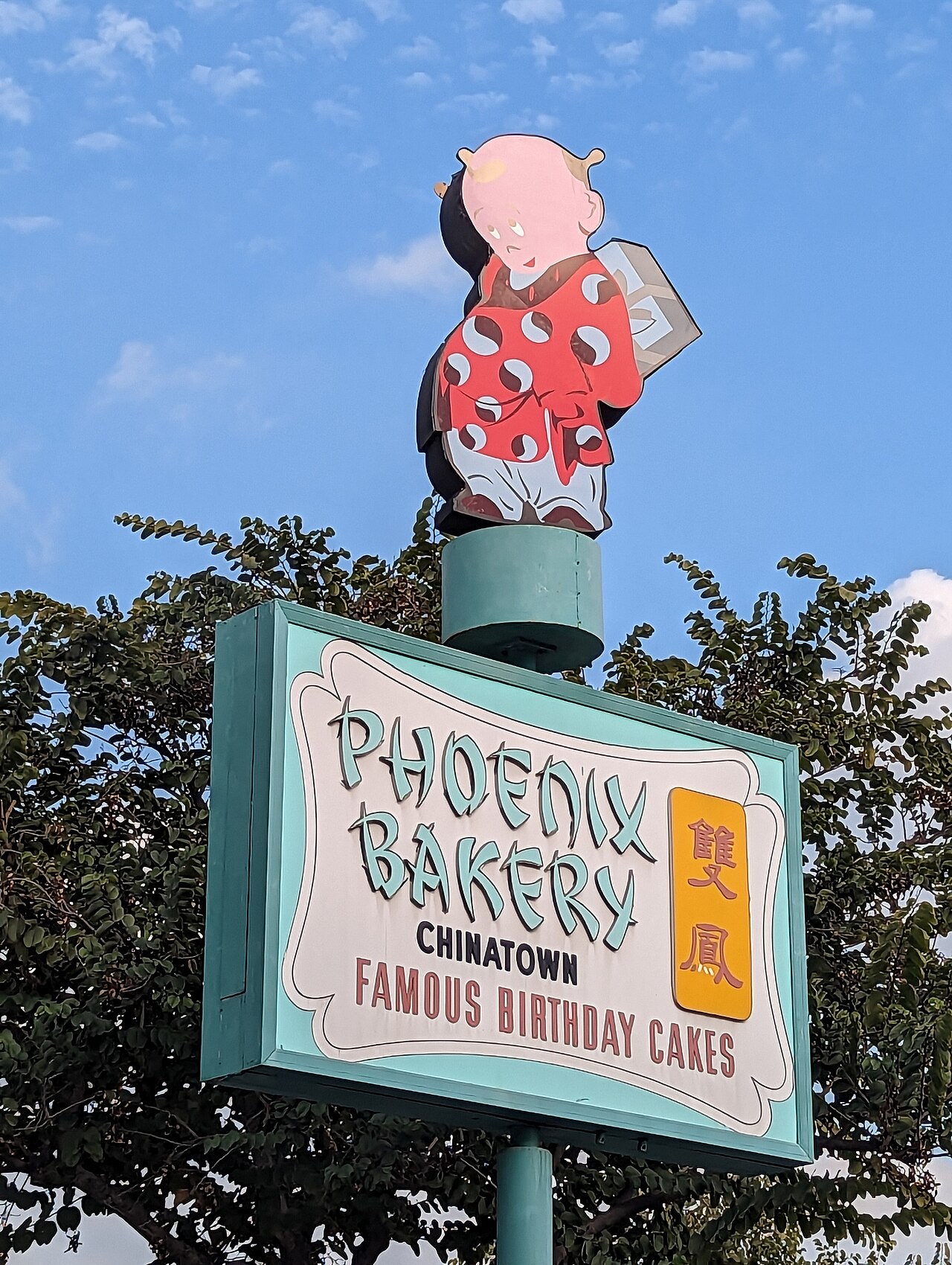
The sign has a story, too. Artist Tyrus Wong designed its shy little boy holding a pastry box. Wong also helped shape the visual world of Disney’s Bambi.
Find the place
Phoenix Bakery is at 969 North Broadway. Its official site recommends advance notice for cake orders, and closing time can depend on selling out. Check before making a special trip.
How we reported this · 12 sources
- Press coverage: laist.com
- Press coverage: lapl.org
- Press coverage: laconservancy.org
- Press coverage: nbclosangeles.com
- Press coverage: lamag.com
- Press coverage: theinfatuation.com
- Press coverage: en.wikipedia.org
- The venue's website: phoenixbakeryinc.com
- The venue's website: phoenixbakeryinc.com
- The venue's website: phoenixbakeryinc.com
- The venue's website: phoenixbakeryinc.com
- The venue's website: phoenixbakeryinc.com
Pull a thread
Where this story goes next
At New Chinatown's first birthday in 1939, the cake was lettered "chop suey."
Place
Chinatown
The first Chinatown
The original Chinatown grew up around Alameda and Macy streets from the 1880s. It was demolished, from 1933, to make room for Union Station.
A plaza from the movies
New Chinatown opened for business in 1938. Community leader Peter Soo Hoo Sr. helped shape it, Hollywood set designers worked on it, and Cecil B. DeMille donated a prop. Its lanes were named Gin Ling Way, Bamboo Lane and Chung King Road, for Chongqing. At the first anniversary in 1939, a giant cake was served lettered "chop suey." Tyrus Wong painted a dragon mural in the plaza, restored by Fu Ding Cheng in 1984.
The neighbors
Phoenix Bakery opened the same year as the plaza and has been a Chan family business ever since; Philippe's is a neighbor on Alameda Street.
Now · Phoenix Bakery, open since the plaza's founding year, celebrated its 88th anniversary in 2026 at 969 North Broadway.
- Philippe the Original French dips on Alameda Street, at the neighborhood's edge today
- Pacific Electric A music room in the neighborhood today
Philippe’s French-dip origin story is disputed. The decision that kept it alive in 1951 is a story worth telling.
Philippe the Original · Chinatown, Los Angeles
The freeway was coming. The family moved the restaurant.
Philippe’s French-dip origin story is disputed. The decision that kept it alive in 1951 is a story worth telling.
Read the storyHollywood began as a town that voted to ban liquor sales. Six years later it joined Los Angeles, for the water.
Place
Hollywood
A town that voted itself dry
Harvey Wilcox filed the name Hollywood with the county recorder in 1887; his wife, Daeida, said she chose it because it sounded nice and holly brings good luck. Hollywood incorporated as its own city in November 1903, by a vote of 88 to 77. Two months later its voters banned liquor sales except for medicine, 113 to 96, so its hotels and restaurants couldn't serve so much as a glass of wine with dinner. The independence didn't last. Hollywood merged with Los Angeles in February 1910 to get a reliable water supply and the city's sewers, and most of Prospect Avenue became Hollywood Boulevard.
Older than the sign
Frank's Cafe, the restaurant that became Musso & Frank, opened on Hollywood Boulevard on September 27, 1919, less than four months before national Prohibition began; one centennial history says the boulevard was still a dirt road. The HOLLYWOODLAND sign went up in the hills in 1923 to sell a housing development, and lost its last four letters in 1949. NPR, marking Musso's centennial, noted the restaurant is older than the sign. The Walk of Fame officially opened in 1960; in 2019 Musso & Frank got a star on it (Wikipedia calls it the first restaurant to receive one).
The writers' block
In the 1930s the studios brought the country's novelists to Hollywood, and the Screen Writers Guild kept offices across the boulevard from Musso & Frank. Stanley Rose's bookshop sat next door to the restaurant, and Alta reported that its owner held literature seminars in a space that housed slot machines. The novelists, as Mark Echeverria tells it, complained at the Guild and then crossed the street to drink at Musso's.
Now · Musso & Frank is still at 6667 Hollywood Boulevard, run by the family of John Mosso, who bought into it in 1927. Its website lists dinner Tuesday to Sunday.
- Musso & Frank Grill Hollywood's oldest restaurant, on the boulevard since 1919
- The Back Room at Musso & Frank Where the studios' novelists drank 1934-1955
- Frolic Room A 1930s bar on the boulevard, next door to the Pantages
- Charles Bukowski Drank on the boulevard, at Musso's among other bars
- The Magic Castle The magicians' clubhouse in a 1909 Hollywood mansion
- Avalon Hollywood The 1927 theater on Vine that became a nightclub
- Roscoe's House of Chicken 'N Waffles Chicken and waffles on Gower
- Yamashiro The 1914 replica of a Japanese palace in the hills above
Before it was a swing club, the Derby was a gas station, a drive-in and a Brown Derby. Now it's a bank.
Venue
The Derby
Gas station, drive-in, Brown Derby, swing club
The building at 4500 Los Feliz Boulevard began as a service station in 1923, the Los Feliz Improvement Association records, became Willard's Car Café by 1930, and in the 1940s was the Los Feliz Brown Derby. Commercial Observer reported that Cecil B. DeMille owned the building at one point. It was Michael's Restaurant from the 1950s until 1993, when Louise's restaurant and the Derby nightclub took over the space.
Swingers' finale
Jon Favreau hung out at the Derby while raising money for Swingers, took swing lessons there and decided it was his ending; he taught Heather Graham some of the steps. Big Bad Voodoo Daddy played there, and the scene was shot while the club was open, with people paying admission on the floor. Trumpeter Glen Marhevka told Grantland that when the band first showed up in suits and fedoras, people stared at them like aliens.
Closed, and protected
The Derby closed in January 2009. The site was declared Los Angeles Historic-Cultural Monument No. 843 in 2006, after which, Commercial Observer reports, the owners' mixed-use plans were scrapped. They put a Chase branch in place of the nightclub, spent $2 million refurbishing the building, and sold it in 2012 for $9.25 million.
Now · The Derby is closed. As of the 2012 sale, a Chase branch occupied the former nightclub; the Los Feliz Improvement Association lists Chase and a restaurant, the Mess Hall, in the building. We have not confirmed the current tenants.
- Swingers (1996) The film that made it famous 1996
- Los Feliz On Los Feliz Boulevard 1993-2009
- The Dresden The other Los Feliz room in Swingers 1996