
Langer's Delicatessen-Restaurant · Westlake, Los Angeles
The bread needed another turn in the oven.
A crisp crust became part of Langer’s identity. Staying in business also meant listening to a new idea from behind the counter.
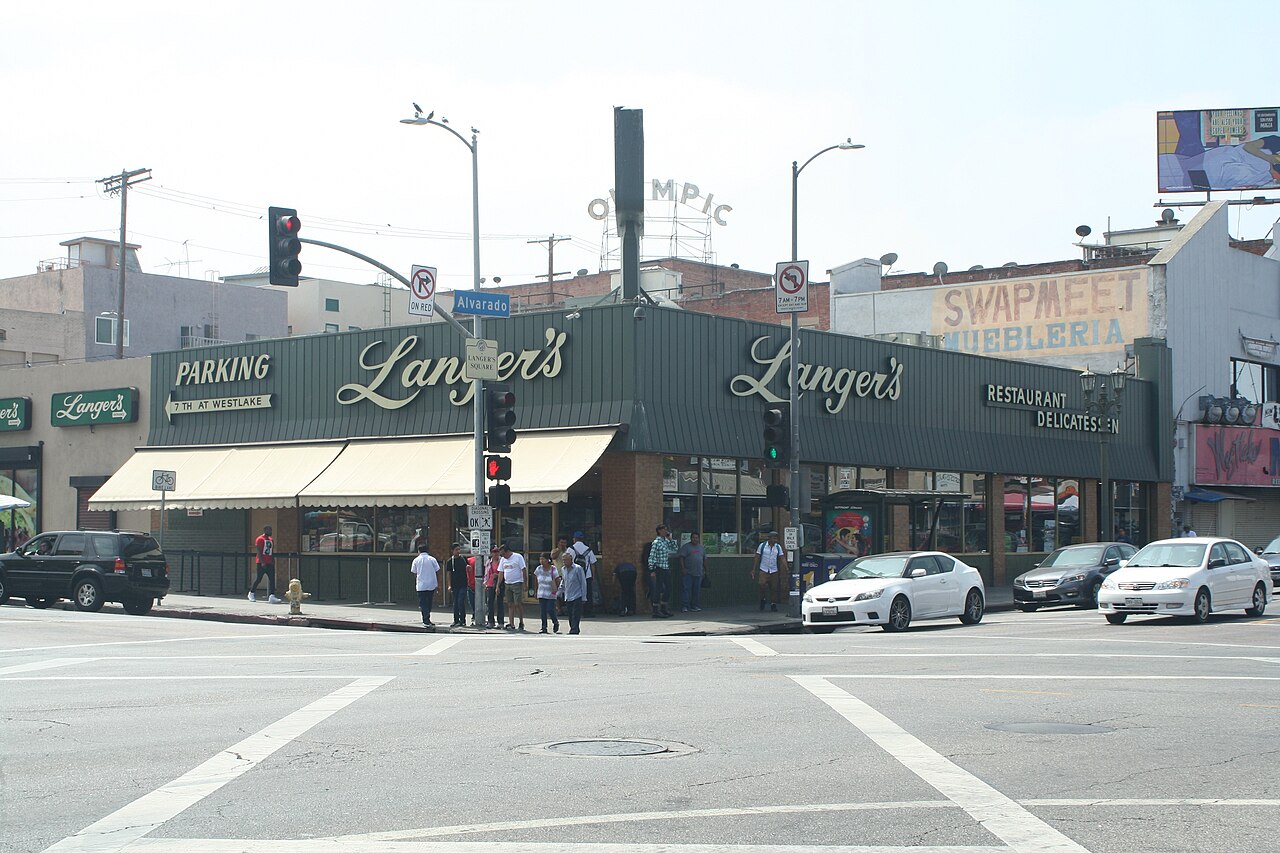
At Langer’s, the bread gets another chance in the oven.
That crisp rye crust is part of the appeal of the deli’s famous pastrami sandwich. Norm Langer recalled his father reheating day-old rye shipped to his Palm Springs deli. The extra turn in the oven improved the crust.
The Palm Springs business did not last. The idea did.
A family builds around a sandwich
Al and Jean Langer opened their Los Angeles deli in 1947. The small restaurant on Alvarado Street grew around food made with particular care.
Pastrami is beef that has been cured, seasoned and smoked. At Langer’s, it is steamed until tender and cut by hand.
The No. 19 puts it on rye with Swiss cheese, coleslaw and Russian dressing. The soft meat and crisp bread do different jobs in the same bite.
Keeping the food. Changing the service.
By the early 1990s, the family was facing a harder business.
One useful suggestion came from counterman Alex Barragan. A 1997 Los Angeles Times account credits him with proposing curbside service: customers could order ahead and collect food without parking for a full visit.
Norm later remembered an employee carrying a sandwich to a customer who was running late. The accounts differ in their details, but both put an employee’s initiative at the beginning of curb service.
The restaurant tried it. Customers gained another way to buy the sandwich.
The nearby Metro station, which opened in 1993, also made the deli easier to reach. Neither change alone explains everything that followed. Together, they show a family business adapting how people got to its food.
The bread could stay twice-baked. The way it reached a customer could change.
Find the place
Langer’s is at 704 South Alvarado Street, near the Westlake/MacArthur Park station. Its official site lists hours and instructions for dining, pickup and curbside orders. Check those before making a trip.
How we reported this · 16 sources
- Press coverage: latimes.com
- Press coverage: latimes.com
- Press coverage: latimes.com
- Press coverage: latimes.com
- Press coverage: latimes.com
- Press coverage: latimes.com
- Press coverage: lamag.com
- Press coverage: foxla.com
- Press coverage: laist.com
- Press coverage: en.wikipedia.org
- The venue's website: langersdeli.com
- The venue's website: langersdeli.com
- The venue's website: langersdeli.com
- The venue's website: langersdeli.com
- The venue's website: langersdeli.com
- The venue's website: langersdeli.com


Pull a thread
Where this story goes next
Canter’s grew from a family deli into a Fairfax gathering place. Then the lounge next door found a second life through the people playing in it.
Canter's Deli · Fairfax District, Los Angeles
The deli where a waiter started a music night
Canter’s grew from a family deli into a Fairfax gathering place. Then the lounge next door found a second life through the people playing in it.
Read the storyHollywood began as a town that voted to ban liquor sales. Six years later it joined Los Angeles, for the water.
Place
Hollywood
A town that voted itself dry
Harvey Wilcox filed the name Hollywood with the county recorder in 1887; his wife, Daeida, said she chose it because it sounded nice and holly brings good luck. Hollywood incorporated as its own city in November 1903, by a vote of 88 to 77. Two months later its voters banned liquor sales except for medicine, 113 to 96, so its hotels and restaurants couldn't serve so much as a glass of wine with dinner. The independence didn't last. Hollywood merged with Los Angeles in February 1910 to get a reliable water supply and the city's sewers, and most of Prospect Avenue became Hollywood Boulevard.
Older than the sign
Frank's Cafe, the restaurant that became Musso & Frank, opened on Hollywood Boulevard on September 27, 1919, less than four months before national Prohibition began; one centennial history says the boulevard was still a dirt road. The HOLLYWOODLAND sign went up in the hills in 1923 to sell a housing development, and lost its last four letters in 1949. NPR, marking Musso's centennial, noted the restaurant is older than the sign. The Walk of Fame officially opened in 1960; in 2019 Musso & Frank got a star on it (Wikipedia calls it the first restaurant to receive one).
The writers' block
In the 1930s the studios brought the country's novelists to Hollywood, and the Screen Writers Guild kept offices across the boulevard from Musso & Frank. Stanley Rose's bookshop sat next door to the restaurant, and Alta reported that its owner held literature seminars in a space that housed slot machines. The novelists, as Mark Echeverria tells it, complained at the Guild and then crossed the street to drink at Musso's.
Now · Musso & Frank is still at 6667 Hollywood Boulevard, run by the family of John Mosso, who bought into it in 1927. Its website lists dinner Tuesday to Sunday.
- Musso & Frank Grill Hollywood's oldest restaurant, on the boulevard since 1919
- The Back Room at Musso & Frank Where the studios' novelists drank 1934-1955
- Frolic Room A 1930s bar on the boulevard, next door to the Pantages
- Charles Bukowski Drank on the boulevard, at Musso's among other bars
- The Magic Castle The magicians' clubhouse in a 1909 Hollywood mansion
- Avalon Hollywood The 1927 theater on Vine that became a nightclub
- Roscoe's House of Chicken 'N Waffles Chicken and waffles on Gower
- Yamashiro The 1914 replica of a Japanese palace in the hills above
He started as a proofreader, interviewed Dr. Dre, and is buried under the words "Tacos Forever."
Person
Jonathan Gold
From proofreader to rap writer
Gold was born in Los Angeles on July 28, 1960. As a UCLA freshman he briefly worked at a kosher restaurant owned by Leah Adler, Steven Spielberg's mother. In 1982 he became a proofreader at LA Weekly, where he met his future wife, Laurie Ochoa, then moved to the music section, writing about classical music and hip-hop and interviewing Snoop Dogg, Dr. Dre and members of N.W.A.
The critic in the strip mall
He started Counter Intelligence in 1986, wrote for the Los Angeles Times from 1990 to 1996, went to New York for Gourmet in 1999 and came back in 2001. In 2007 he became the first food critic to win the Pulitzer Prize for Criticism, for his LA Weekly reviews, and in 2012 he became the Times' chief critic. Anthony Bourdain said he was the first to turn the focus from white tablecloths to "really cool little places in strip malls." LAist wrote that he saw the city as a mosaic, an "anti-melting pot."
No notebook at the table
He would not take notes at dinner: "Taking notes while you're eating is like taking notes while you're making love." LAist recalled him returning to one Taiwanese restaurant 16 or 17 times. "There are definitely moments when you're eating with me that I will be in a trance state," he said. Los Angeles Magazine wrote that he gave the same attention to trucks and stands as to fine dining.
Tacos Forever
Gold died of pancreatic cancer on July 21, 2018, at 57. On July 28, his birthday, buildings and landmarks across Los Angeles were lit in gold. The James Beard Foundation renamed its Local Impact Award the Jonathan Gold Local Voice Award, and in 2019 gave him a posthumous award. He is buried at Hollywood Forever Cemetery under the epitaph "Tacos Forever."
- Counter Intelligence His column and book 1986-2018
- Jitlada Championed Tui Sungkamee's Southern Thai cooking
- Guelaguetza A family restaurant he championed, per the James Beard Foundation
- King Taco #1 Called its tacos "solid B+ tacos" and said it may have set the modern LA taco sensibility 2013
The Valley's population quintupled in 15 years after the war. Its oldest tiki bar opened right in the middle of the boom.
Place
San Fernando Valley
Water for a vote
Most of the Valley became Los Angeles for the water. In 1915 rural towns voted to join the city so they could tap its water system, fed by the new aqueduct. Lankershim, the town that became North Hollywood, joined in 1923. Much later a movement to split the Valley off as its own city gained some momentum, but its ballot measure, Measure F, did not get the votes to pass.
The boom
Between 1945 and 1960 the Valley's population quintupled. In 1958, in the middle of it, the brothers Ace and Ed Libby, who had worked at a Polynesian restaurant on Sepulveda Boulevard in Van Nuys, opened the Tonga Hut on Victory Boulevard in North Hollywood. It is still pouring, and calls itself LA's oldest tiki bar.
A local bar first
The Tonga Hut's manager, Marie King, credited its survival to being both a tiki bar and a local bar, and a regular named Dottie came six days a week from 1961 until her death in 2010; the staff keep her seat marked with a Reserved sign at happy hour.
Now · As of 2023 about 1.8 million people lived in the Valley. The Tonga Hut on Victory Boulevard lists its hours and both drinking challenges as current on its own site in October 2026.
- Tonga Hut The Valley's 1958 tiki bar, still pouring since 1958
- Bob's Big Boy Another Valley-side room on our slate see its story
- Casa Vega Another Valley room on our slate see its story