
Bob's Big Boy · Burbank
They saved the diner. The classic cars gather outside.
Bob’s Big Boy in Burbank survived a demolition threat. Its neon, drive-in design and car gatherings keep a piece of roadside Los Angeles in motion.
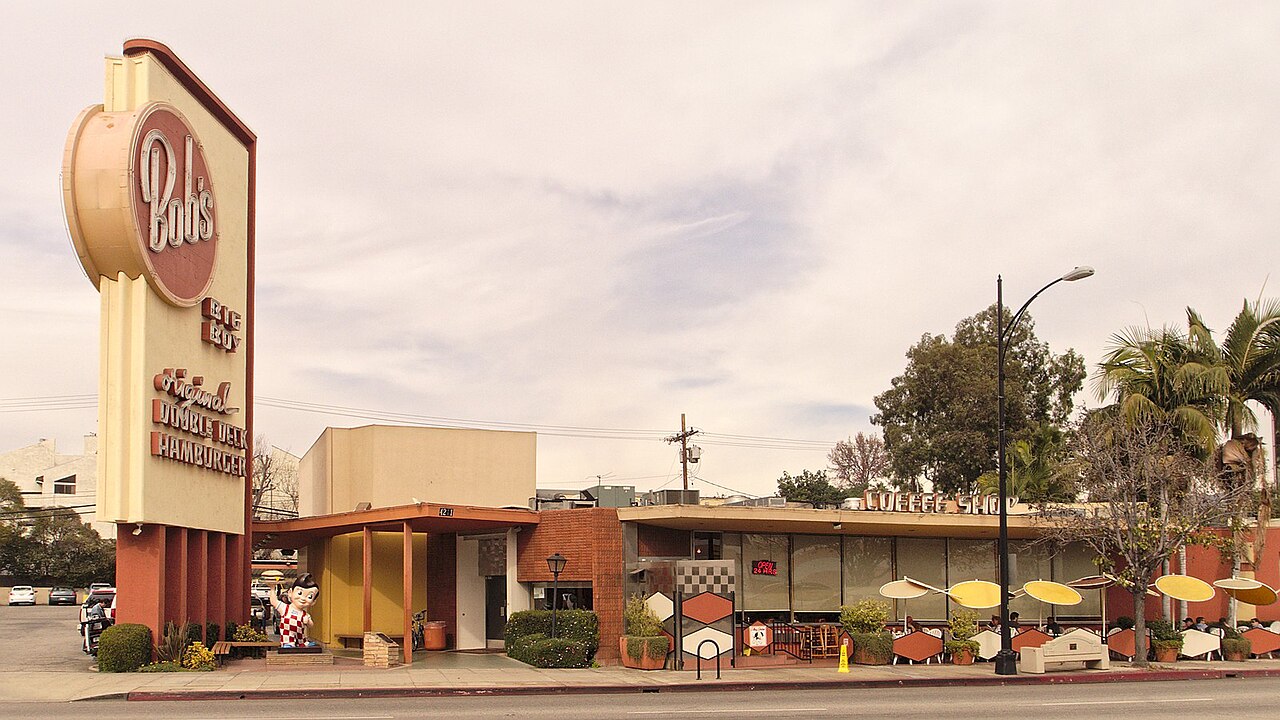
Bob’s Big Boy in Burbank was built to catch your eye from a car. Decades later, people had to make a different case for it: why the building should stay.
The 1949 restaurant faced demolition in the 1990s. Preservationists pushed to save it. California recognized it as a Point of Historical Interest in 1992, and restoration followed.
A familiar hamburger stand had become something worth protecting.
A building for a city on wheels
Architect Wayne McAllister designed the restaurant for Scott MacDonald and Ward Albert. His work also included major hotels in Las Vegas.
Here, he made a low building with broad windows and a neon tower. You could see the room from the road. The former drive-in area had a steel awning shaped like a boomerang.
That is the appeal of this kind of architecture: it turns stopping for a meal into a roadside event.
Bringing back more than the sign
The restaurant’s history says the MacDonald family took control in 1993 and restored the property. Work included the dining room, patio and tower sign.
Classic cars became part of the revival. The restaurant hosts a recurring gathering with the Road Kings of Burbank. The cars belong in the picture because the building was designed around them.
A good story, with a little distance
A booth plaque commemorates a visit the restaurant says the Beatles made in 1965. That is the house account; independent documentation remains uncertain.
The booth plaque preserves the restaurant’s account of that visit.
Bob’s is at 4211 West Riverside Drive. Check its official site for the car-show schedule and current restaurant hours.
How we reported this · 14 sources
- The venue's website: bobs.net
- The venue's website: bobs.net
- The venue's website: bobs.net
- The venue's website: bobs.net
- The venue's website: bobs.net
- The venue's website: bobs.net
- The venue's website: bobs.net
- The venue's website: bobs.net
- The venue's website: bobs.net
- Press coverage: laconservancy.org
- Press coverage: thetakeout.com
- Press coverage: en.wikipedia.org
- Press coverage: en.wikipedia.org
- Press coverage: lamag.com
Pull a thread
Where this story goes next
Hollywood began as a town that voted to ban liquor sales. Six years later it joined Los Angeles, for the water.
Place
Hollywood
A town that voted itself dry
Harvey Wilcox filed the name Hollywood with the county recorder in 1887; his wife, Daeida, said she chose it because it sounded nice and holly brings good luck. Hollywood incorporated as its own city in November 1903, by a vote of 88 to 77. Two months later its voters banned liquor sales except for medicine, 113 to 96, so its hotels and restaurants couldn't serve so much as a glass of wine with dinner. The independence didn't last. Hollywood merged with Los Angeles in February 1910 to get a reliable water supply and the city's sewers, and most of Prospect Avenue became Hollywood Boulevard.
Older than the sign
Frank's Cafe, the restaurant that became Musso & Frank, opened on Hollywood Boulevard on September 27, 1919, less than four months before national Prohibition began; one centennial history says the boulevard was still a dirt road. The HOLLYWOODLAND sign went up in the hills in 1923 to sell a housing development, and lost its last four letters in 1949. NPR, marking Musso's centennial, noted the restaurant is older than the sign. The Walk of Fame officially opened in 1960; in 2019 Musso & Frank got a star on it (Wikipedia calls it the first restaurant to receive one).
The writers' block
In the 1930s the studios brought the country's novelists to Hollywood, and the Screen Writers Guild kept offices across the boulevard from Musso & Frank. Stanley Rose's bookshop sat next door to the restaurant, and Alta reported that its owner held literature seminars in a space that housed slot machines. The novelists, as Mark Echeverria tells it, complained at the Guild and then crossed the street to drink at Musso's.
Now · Musso & Frank is still at 6667 Hollywood Boulevard, run by the family of John Mosso, who bought into it in 1927. Its website lists dinner Tuesday to Sunday.
- Musso & Frank Grill Hollywood's oldest restaurant, on the boulevard since 1919
- The Back Room at Musso & Frank Where the studios' novelists drank 1934-1955
- Frolic Room A 1930s bar on the boulevard, next door to the Pantages
- Charles Bukowski Drank on the boulevard, at Musso's among other bars
- The Magic Castle The magicians' clubhouse in a 1909 Hollywood mansion
- Avalon Hollywood The 1927 theater on Vine that became a nightclub
- Roscoe's House of Chicken 'N Waffles Chicken and waffles on Gower
- Yamashiro The 1914 replica of a Japanese palace in the hills above