
Canter's Deli · Fairfax District, Los Angeles
The deli where a waiter started a music night
Canter’s grew from a family deli into a Fairfax gathering place. Then the lounge next door found a second life through the people playing in it.
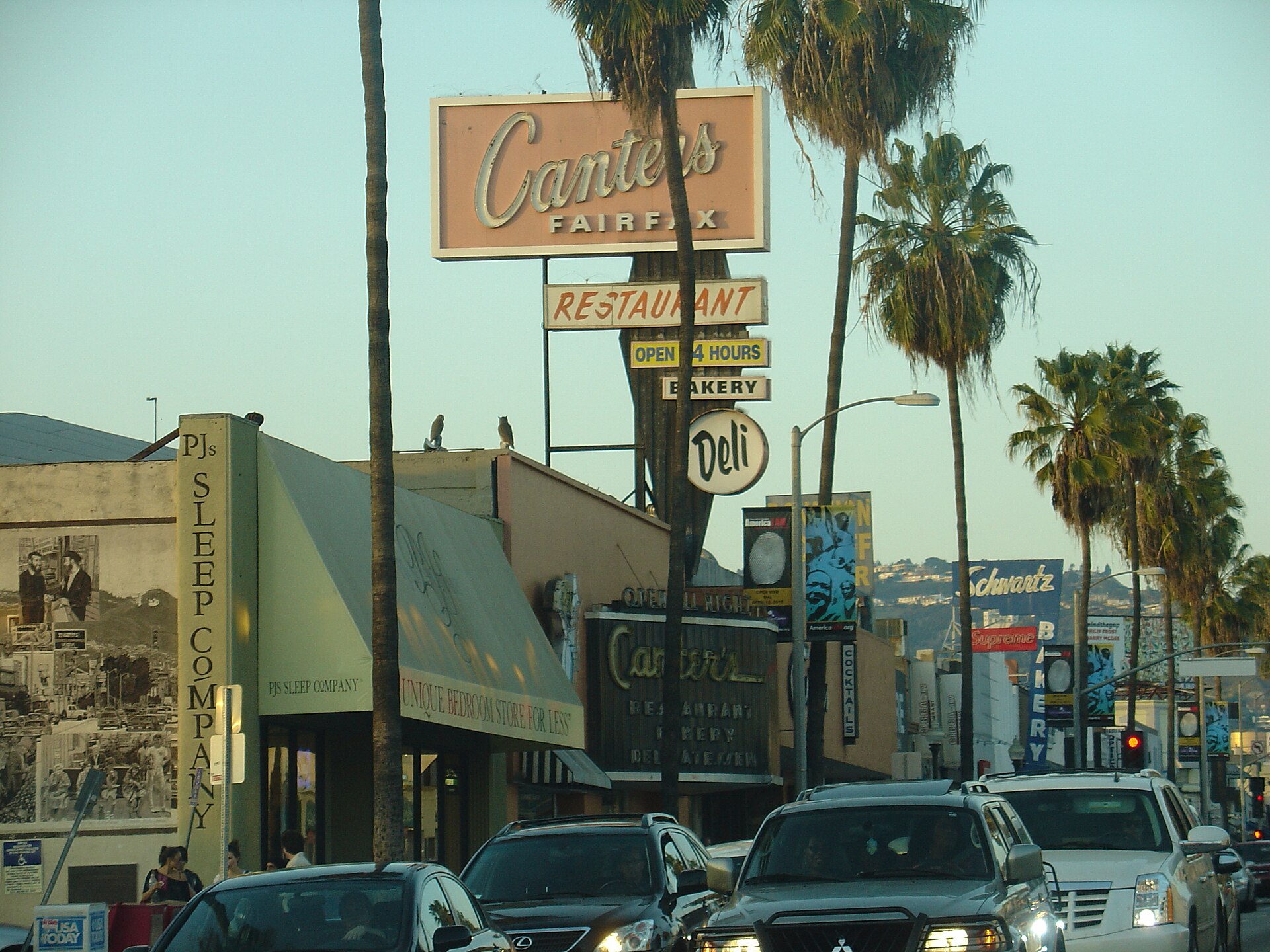
Around 1989, Canter’s waiter Eric Gold wanted somewhere for his jazz band to play. He found a stage in the deli’s lounge.
Gold got permission to bring music to the Kibitz Room. What followed grew beyond his original idea, according to his account in InsideHook.
Young musicians found the room. Keyboardist Rami Jaffee asked Marc Canter for a night of his own. A space beside the sandwiches became a place where musical relationships took shape.
First came the family deli
The Canter family opened in Boyle Heights in 1931 after leaving New Jersey. Their business later followed part of Los Angeles’s Jewish community west to Fairfax.
In 1953, the family moved into a former movie theater. The building had shown Yiddish-language films. Its high ceiling helps explain why this deli feels larger than a typical lunch counter.
The family bought neighboring space and opened the Kibitz Room in 1961. To kibitz is to chat, joke or offer advice—an appropriate name for a room built around company.
A room becomes a meeting place
For years, the lounge also served as overflow seating. The later music nights gave people a new reason to return.
InsideHook reports that Jaffee met Jakob Dylan in 1990 and heard a demo in the Canter’s parking lot. Their connection led to Jaffee joining the Wallflowers.
Marc Canter had his own longstanding friendship with Slash. He photographed early Guns N’ Roses shows and later published a book about those years. The deli’s music history grew through friendships and work, not just famous people ordering dinner.
The bakery case is part of it
Canter’s is still a deli as well as a cultural meeting point. The sandwiches, pastries and people working the room belong in the story alongside the musicians.
Find it at 419 North Fairfax Avenue. Check the official deli and Kibitz Room pages separately for current hours and performances; do not assume every night is an all-night one.
How we reported this · 21 sources
- The venue's website: cantersdeli.com
- The venue's website: cantersdeli.com
- The venue's website: cantersdeli.com
- Press coverage: cbsnews.com
- Press coverage: abc7.com
- Press coverage: lamag.com
- Press coverage: lataco.com
- Press coverage: insidehook.com
- Press coverage: laist.com
- Press coverage: beverlypress.com
- Press coverage: complex.com
- Press coverage: highsnobiety.com
- Press coverage: timeout.com
- Press coverage: punchdrink.com
- Public record: laconservancy.org
- Public record: scalar.usc.edu
- Public record: cinematreasures.org
- Press coverage: en.wikipedia.org
- Press coverage: en.wikipedia.org
- Press coverage: en.wikipedia.org
- The venue's website: cantersdeli.com
Pull a thread
Where this story goes next
A crisp crust became part of Langer’s identity. Staying in business also meant listening to a new idea from behind the counter.
Langer's Delicatessen-Restaurant · Westlake, Los Angeles
The bread needed another turn in the oven.
A crisp crust became part of Langer’s identity. Staying in business also meant listening to a new idea from behind the counter.
Read the storyHollywood began as a town that voted to ban liquor sales. Six years later it joined Los Angeles, for the water.
Place
Hollywood
A town that voted itself dry
Harvey Wilcox filed the name Hollywood with the county recorder in 1887; his wife, Daeida, said she chose it because it sounded nice and holly brings good luck. Hollywood incorporated as its own city in November 1903, by a vote of 88 to 77. Two months later its voters banned liquor sales except for medicine, 113 to 96, so its hotels and restaurants couldn't serve so much as a glass of wine with dinner. The independence didn't last. Hollywood merged with Los Angeles in February 1910 to get a reliable water supply and the city's sewers, and most of Prospect Avenue became Hollywood Boulevard.
Older than the sign
Frank's Cafe, the restaurant that became Musso & Frank, opened on Hollywood Boulevard on September 27, 1919, less than four months before national Prohibition began; one centennial history says the boulevard was still a dirt road. The HOLLYWOODLAND sign went up in the hills in 1923 to sell a housing development, and lost its last four letters in 1949. NPR, marking Musso's centennial, noted the restaurant is older than the sign. The Walk of Fame officially opened in 1960; in 2019 Musso & Frank got a star on it (Wikipedia calls it the first restaurant to receive one).
The writers' block
In the 1930s the studios brought the country's novelists to Hollywood, and the Screen Writers Guild kept offices across the boulevard from Musso & Frank. Stanley Rose's bookshop sat next door to the restaurant, and Alta reported that its owner held literature seminars in a space that housed slot machines. The novelists, as Mark Echeverria tells it, complained at the Guild and then crossed the street to drink at Musso's.
Now · Musso & Frank is still at 6667 Hollywood Boulevard, run by the family of John Mosso, who bought into it in 1927. Its website lists dinner Tuesday to Sunday.
- Musso & Frank Grill Hollywood's oldest restaurant, on the boulevard since 1919
- The Back Room at Musso & Frank Where the studios' novelists drank 1934-1955
- Frolic Room A 1930s bar on the boulevard, next door to the Pantages
- Charles Bukowski Drank on the boulevard, at Musso's among other bars
- The Magic Castle The magicians' clubhouse in a 1909 Hollywood mansion
- Avalon Hollywood The 1927 theater on Vine that became a nightclub
- Roscoe's House of Chicken 'N Waffles Chicken and waffles on Gower
- Yamashiro The 1914 replica of a Japanese palace in the hills above