
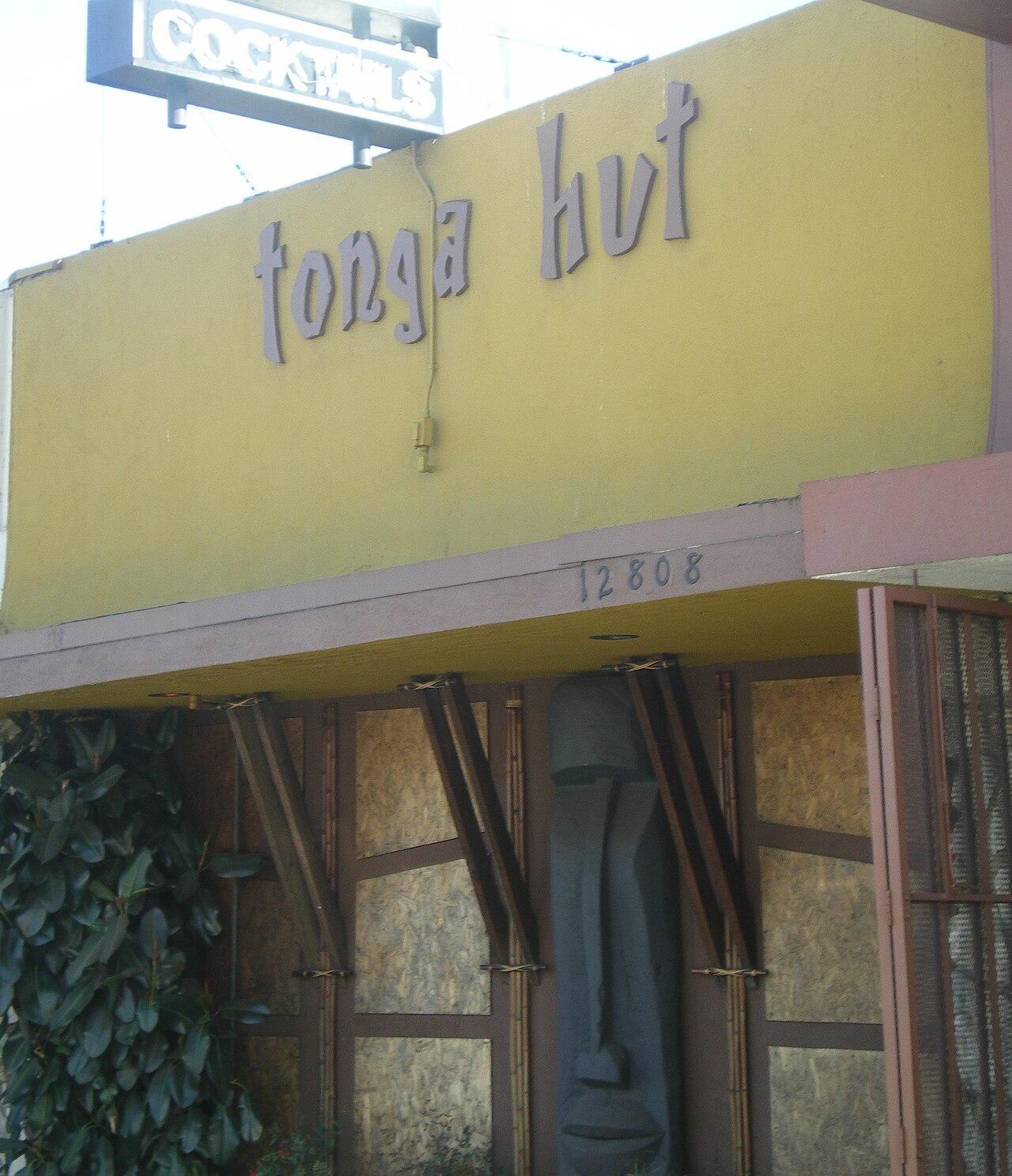
Tonga Hut · North Hollywood, Los Angeles
The regulars helped keep the tiki bar alive.
Tonga Hut survived as a neighborhood gathering place. Its revival made room for both the old customers and new enthusiasts.
Dottie came to Tonga Hut six days a week.
After she died in 2010, staff marked her seat with a reserved sign during happy hour, according to later reporting.
The reserved seat kept a regular’s place in the room after her death.
A fantasy room with ordinary regulars
Brothers Ace and Ed Libby opened Tonga Hut in North Hollywood in 1958.
The décor drew on the American tiki-bar tradition, a mix of imagined tropical settings rather than an accurate representation of any single Pacific culture. The name refers to the Kingdom of Tonga.
Inside, fountains and carved figures created an escape from Victory Boulevard. The regulars made it familiar.
Bringing the room back into focus
Jeremy Fleener and Ana Reyes bought the bar in 2005. A renewed interest in tiki drinks and design became part of its next chapter.
Later manager Marie King described the balance plainly in interviews: it was a tiki bar and a neighborhood bar.
Customers made their own plaques for a wall associated with the bar’s cocktail-list club. The most interesting feature is the handmade collection, each little object marking someone’s attachment to the room.
During the pandemic, a new outdoor area filled with donated décor, including plants and a vintage swordfish.
The place kept changing through things people brought to it.
Its claim to be Los Angeles’s oldest surviving tiki bar comes with a distinction: Tiki-Ti has its own history of continuous tropical-drink making.
Both stories show how a designed fantasy can become a real community space.
Find the place
Tonga Hut is at 12808 Victory Boulevard. Check its official site for current hours, events, age rules and group reservations. The North Hollywood location and the later Palm Springs venue have separate arrangements.
How we reported this · 9 sources
- The venue's website: tongahut.com
- The venue's website: tongahut.com
- Press coverage: lamag.com
- Press coverage: lamag.com
- Press coverage: welikela.com
- Press coverage: two-nineteen.com
- Press coverage: en.wikipedia.org
- Press coverage: en.wikipedia.org
- Press coverage: en.wikipedia.org
Pull a thread
Where this story goes next
A tiki historian collected 78 recipes the old bars nearly lost. One North Hollywood bar dares you to drink the whole book in a year.
Work
Beachbum Berry's Grog Log
Seventy-eight recipes
Jeff Berry, the tiki historian who signs himself Beachbum, published Grog Log in 1998: 78 tiki recipes in one book. Wikipedia calls it pivotal to the tiki revival. He followed it with Intoxica! in 2003, Taboo Table in 2005 and Sippin' Safari in 2007.
A recipe written in code
Sippin' Safari includes what Berry believes is Donn Beach's original Zombie, a recipe that had survived only in code. The writer Wayne Curtis called him the Indiana Jones of tiki drinks. In 2014 Berry and his wife, Annene Kaye, opened their own bar, Beachbum Berry's Latitude 29, in New Orleans' French Quarter.
A book you drink
At the Tonga Hut in North Hollywood, the Grog Log is a dare: drink all 78 recipes within 12 months and you join the Loyal Order of the Drooling Bastard, with a plaque on the wall. Finish it and the bar offers round two, the Intoxica List.
Now · The Tonga Hut's events page lists the Grog Log challenge as open at both its North Hollywood and Palm Springs bars.
- Donn Beach Berry believes he found Donn's original Zombie, written in code published 2007
- Don the Beachcomber The bar whose Zombie Berry chased 1930s onward
- Who invented the Mai Tai? Another tiki recipe with a fight over who made it first 1930s to now
After years making other people’s tropical drinks, the Filipino bartender built a small bar of his own.
Tiki-Ti · Los Feliz, Los Angeles
Ray Buhen wanted customers to see who made their drinks
After years making other people’s tropical drinks, the Filipino bartender built a small bar of his own.
Read the storyBefore he was Donn Beach he was Ernest Gantt, broke and parking cars in LA. Filipino friends put him up, and he promised to hire them all.
Person
Donn Beach
The promise
Ernest Raymond Beaumont Gantt reached Southern California in December 1931, 24 and out of money. By his own telling he had drifted through Jamaica, Tahiti, Australia and Papua New Guinea; KCET called him a spinner of tall tales. In Los Angeles he parked cars, worked in restaurants and, American Heritage reports, did a bit of bootlegging before Prohibition ended. Jeff Berry has said that Filipino workers put him up, and that Gantt promised that when he got his own place, he would hire all of them. When his bar opened, its bar and service staff were overwhelmingly Filipino.
A U-boat, then Waikiki
In the Second World War he was commissioned, and his ship, in a convoy bound for Morocco, was attacked by a U-boat. He was hurt, then spent the rest of the war running rest hotels for airmen on Capri, in Venice and on the French Riviera. Back home, he found that his ex-wife and business partner, Sunny Sund, had turned Don the Beachcomber into a chain. He signed the mainland restaurants over to her, stayed on as a consultant and left for Waikiki, where he opened his own Don the Beachcomber, ran his business from an office in a banyan tree and kept a myna bird trained to squawk "Give me a beer, stupid!"
Eighty-four drinks
He died in Honolulu in 1989. The New York Times obituary, as American Heritage describes it, painted him as a sort of Thomas Edison of the thatched-roof bar and credited him with 84 drinks, including the Mai Tai. That last credit is still argued over.
- Don the Beachcomber The bar he opened, and the name he took from 1933
- Ray Buhen One of his first bartenders from 1934
- Tiki's Filipino bartenders Hired the Filipino friends who had put him up 1930s
- Who invented the Mai Tai? His widow said he had a Mai Tai first
- Tiki-Ti Where his Zombie is still poured since 1961
The Valley's population quintupled in 15 years after the war. Its oldest tiki bar opened right in the middle of the boom.
Place
San Fernando Valley
Water for a vote
Most of the Valley became Los Angeles for the water. In 1915 rural towns voted to join the city so they could tap its water system, fed by the new aqueduct. Lankershim, the town that became North Hollywood, joined in 1923. Much later a movement to split the Valley off as its own city gained some momentum, but its ballot measure, Measure F, did not get the votes to pass.
The boom
Between 1945 and 1960 the Valley's population quintupled. In 1958, in the middle of it, the brothers Ace and Ed Libby, who had worked at a Polynesian restaurant on Sepulveda Boulevard in Van Nuys, opened the Tonga Hut on Victory Boulevard in North Hollywood. It is still pouring, and calls itself LA's oldest tiki bar.
A local bar first
The Tonga Hut's manager, Marie King, credited its survival to being both a tiki bar and a local bar, and a regular named Dottie came six days a week from 1961 until her death in 2010; the staff keep her seat marked with a Reserved sign at happy hour.
Now · As of 2023 about 1.8 million people lived in the Valley. The Tonga Hut on Victory Boulevard lists its hours and both drinking challenges as current on its own site in October 2026.
- Bob's Big Boy Another Valley-side room on our slate see its story
- Casa Vega Another Valley room on our slate see its story
1 more thread
Hollywood began as a town that voted to ban liquor sales. Six years later it joined Los Angeles, for the water.
Place
Hollywood
A town that voted itself dry
Harvey Wilcox filed the name Hollywood with the county recorder in 1887; his wife, Daeida, said she chose it because it sounded nice and holly brings good luck. Hollywood incorporated as its own city in November 1903, by a vote of 88 to 77. Two months later its voters banned liquor sales except for medicine, 113 to 96, so its hotels and restaurants couldn't serve so much as a glass of wine with dinner. The independence didn't last. Hollywood merged with Los Angeles in February 1910 to get a reliable water supply and the city's sewers, and most of Prospect Avenue became Hollywood Boulevard.
Older than the sign
Frank's Cafe, the restaurant that became Musso & Frank, opened on Hollywood Boulevard on September 27, 1919, less than four months before national Prohibition began; one centennial history says the boulevard was still a dirt road. The HOLLYWOODLAND sign went up in the hills in 1923 to sell a housing development, and lost its last four letters in 1949. NPR, marking Musso's centennial, noted the restaurant is older than the sign. The Walk of Fame officially opened in 1960; in 2019 Musso & Frank got a star on it (Wikipedia calls it the first restaurant to receive one).
The writers' block
In the 1930s the studios brought the country's novelists to Hollywood, and the Screen Writers Guild kept offices across the boulevard from Musso & Frank. Stanley Rose's bookshop sat next door to the restaurant, and Alta reported that its owner held literature seminars in a space that housed slot machines. The novelists, as Mark Echeverria tells it, complained at the Guild and then crossed the street to drink at Musso's.
Now · Musso & Frank is still at 6667 Hollywood Boulevard, run by the family of John Mosso, who bought into it in 1927. Its website lists dinner Tuesday to Sunday.
- Musso & Frank Grill Hollywood's oldest restaurant, on the boulevard since 1919
- The Back Room at Musso & Frank Where the studios' novelists drank 1934-1955
- Frolic Room A 1930s bar on the boulevard, next door to the Pantages
- Charles Bukowski Drank on the boulevard, at Musso's among other bars
- The Magic Castle The magicians' clubhouse in a 1909 Hollywood mansion
- Avalon Hollywood The 1927 theater on Vine that became a nightclub
- Roscoe's House of Chicken 'N Waffles Chicken and waffles on Gower
- Yamashiro The 1914 replica of a Japanese palace in the hills above