
The Troubadour · West Hollywood
The Troubadour, the room that made Elton John overnight
On August 25, 1970, an English songwriter almost nobody in the room had heard of sat down at the Troubadour's house piano. By the end of the night he was a star. The club has outlasted Lenny Bruce's arrest, Lennon's ejection and a pandemic.
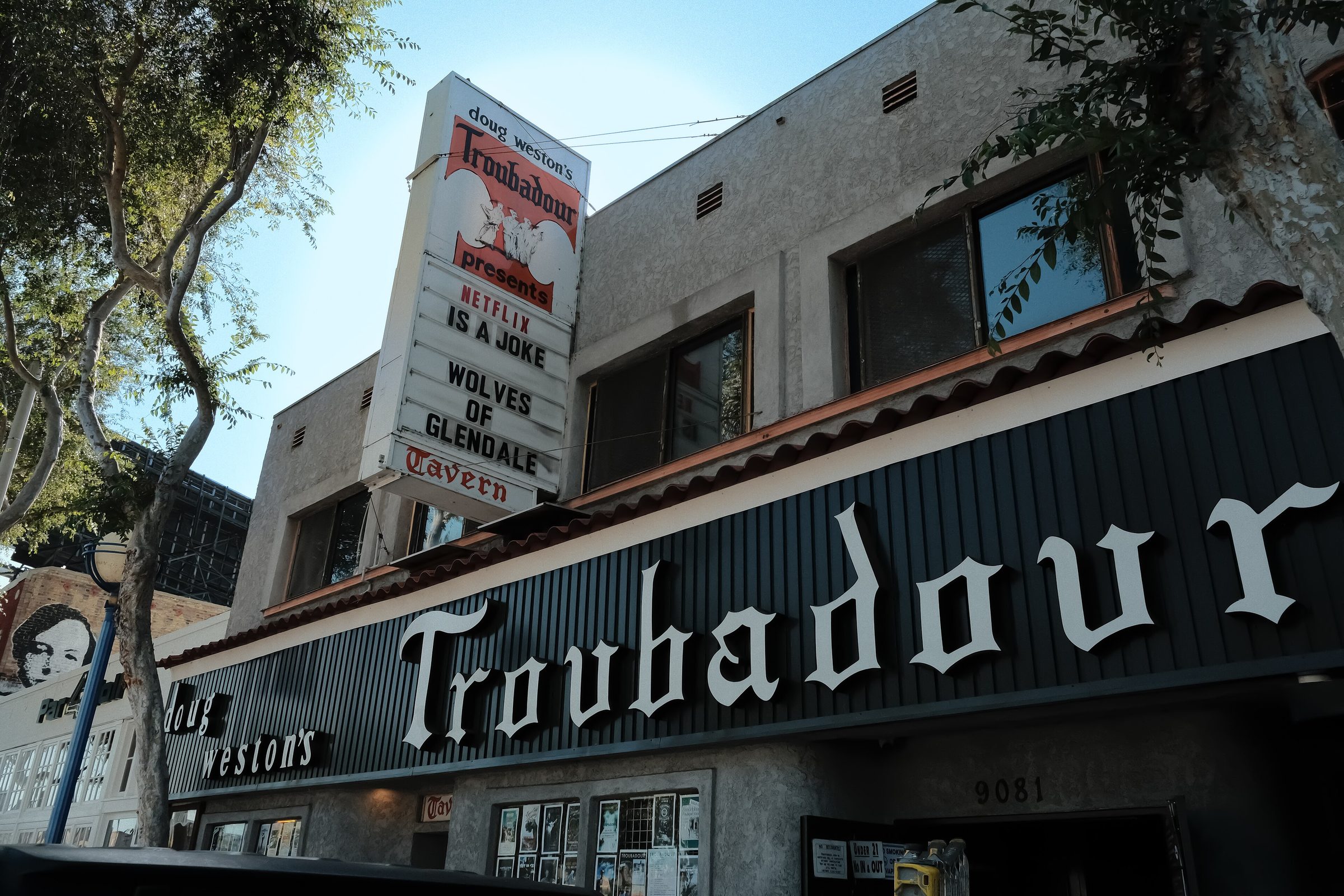
On August 25, 1970, Neil Diamond walked onstage at the Troubadour to introduce an English songwriter almost nobody in the room had heard of. Most of the audience hadn't paid the $5 cover; the label had filled the place with industry guests. The young man sat down at the house piano and played. Two days later, the Los Angeles Times critic Robert Hilburn wrote that he was going to be one of rock's biggest stars. The producer Peter Asher put it more simply: before that show, no one had heard of Elton John, and after it, he was a superstar.
Five weeks
Doug Weston opened the Troubadour as a 65-seat coffeehouse on La Cienega in 1957 and moved it to Santa Monica Boulevard in 1961. He had a rule: acts signed contracts that brought them back to play again, at their old fee, once they got big. Steve Martin, who played there, remembered it this way: when you signed up, you signed up for five weeks.
Monday was Hoot Night, the open mic. Linda Ronstadt has said that if you wanted to get known, that's where you went. Lou Adler found Cheech and Chong at a Monday hoot in 1970. Buffalo Springfield played its first show on that stage in 1966.
Trouble
In October 1962, Lenny Bruce was arrested for what he had said on the Troubadour's stage the night before, and the obscenity trial that followed opened in Beverly Hills that December. In March 1974, John Lennon and Harry Nilsson were thrown out for heckling the Smothers Brothers. Lennon's explanation afterward was that he got drunk and shouted. Tommy Smothers said his wife ended up with Lennon's glasses.
Two families
By the early 1980s the club was struggling, and Weston brought in a friend, a mechanic named Ed Karayan, to help save it. Karayan's daughter Christine started as a teenage helper, came back after college as general manager, and runs it today. In nearly seven decades, the Troubadour has belonged to two families.
In March 2020 it went dark, and a fundraiser for its hourly staff raised about $70,000. It reopened in June 2021. It is still independent, owned by neither of the two giant concert companies, and lives on its bar and on the people who keep coming back. Christine Karayan's way of putting it: if the wall is falling, she'll stand there and hold it up. In April 2026, Pollstar named it nightclub of the year.
If you go: stand close to the stage. It's the same one.
How we reported this
- Press coverage: https://www.eltonjohn.com/stories/eltons-first-shows-in-the-u-s-a-look-back
- Press coverage: https://performingsongwriter.com/elton-john-american-debut-troubadour/
- Press coverage: https://www.cbsnews.com/amp/losangeles/news/troubadour-gofundme-coronavirus-west-hollywood/
- Press coverage: https://www.pbs.org/wnet/americanmasters/archive/?p=395
- Press coverage: https://famous-trials.com/lennybruce/558-chronology
- Press coverage: https://ultimateclassicrock.com/john-lennon-harry-nilsson-troubadour/
- Press coverage: https://www.visitwesthollywood.com/stories/feature-the-troubadour/
- Press coverage: https://wehoonline.com/troubadour-keeps-indie-spirit-alive-nearly-70-years/
- Press coverage: https://www.radiobigboy.com/content/2026-04-16-37th-annual-pollstar-awards-the-complete-list-of-winners/
- Press coverage: https://pcad.lib.washington.edu/building/2559
- The venue's website: https://www.troubadour.com/history