
The Comedy Store · Sunset Strip, West Hollywood
The comics wanted more than stage time.
In 1979, performers picketed the Comedy Store over pay. The dispute forced a hard question about the value of opportunity.
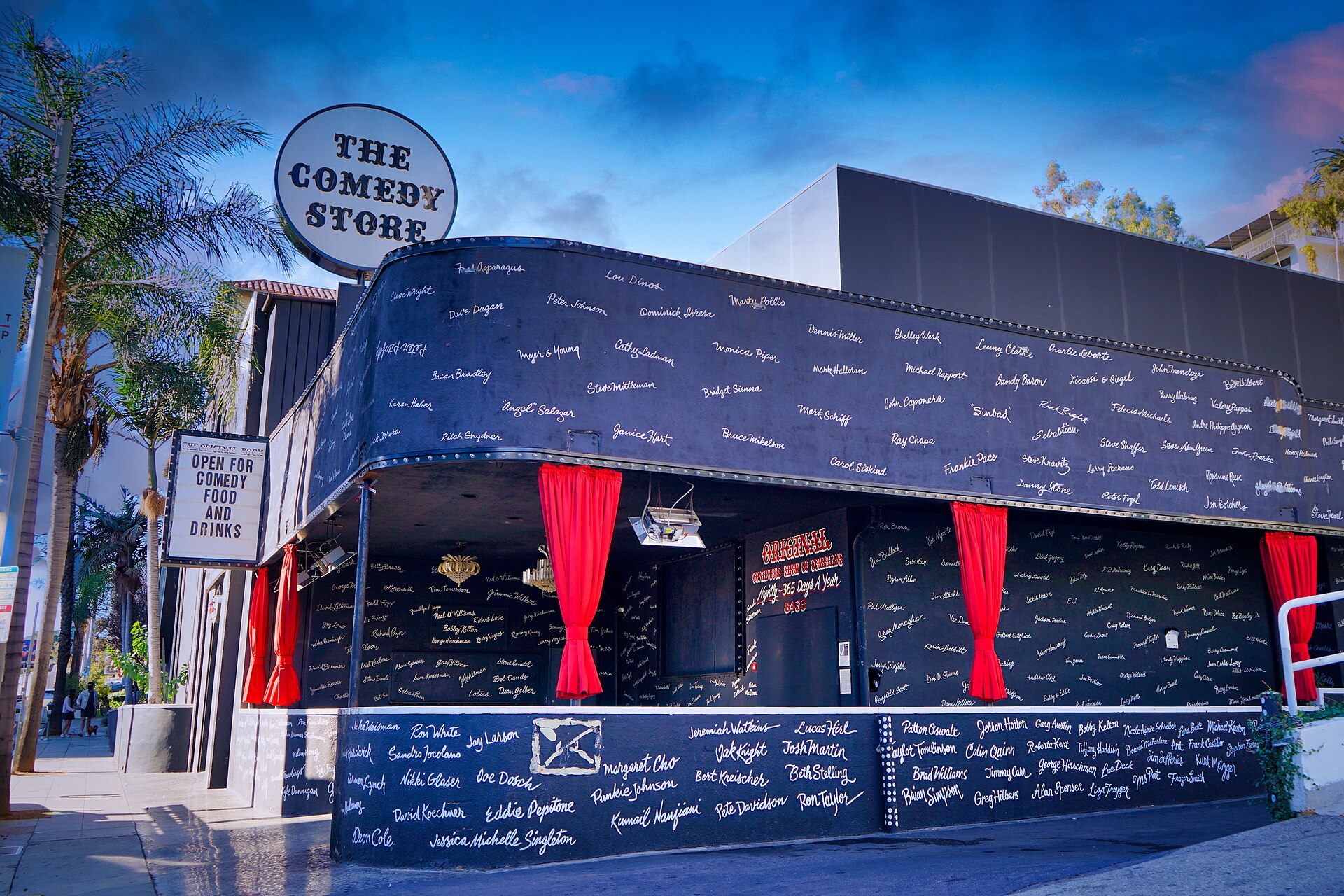
In 1979, comedians picketed the Comedy Store while others kept performing inside. The dispute was about pay.
The club gave comics a place to practice and be seen. They wanted to know why performing there should mean working for free.
The room that could change a career
Mitzi Shore helped build the club into a place where performers developed acts and found an audience.
She offered stage time, attention and access to a comedy community. Some performers worked the door before appearing onstage.
Shore saw the club partly as a training ground. Many of the comics saw customers buying tickets to watch their labor.
Those views collided over money.
An argument moves onto the sidewalk
After some Main Room performances began receiving payment, comics in other rooms wanted compensation too.
Performers organized as Comedians for Compensation. Jay Leno and David Letterman were among the picketers. Others stayed loyal to Shore and continued appearing inside.
Negotiators met nearby. An agreement in June 1979 established payment for performances covered by the deal.
Accounts differ on the dispute’s starting date and duration. The outcome is clearer than a neat day-by-day version: organizing changed the payment arrangement.
Opportunity had a price
The conflict damaged relationships. It also exposed two truths that were difficult to fit together.
The room had helped people develop. The people had helped make the room valuable.
The agreement changed pay arrangements, but it did not repair every relationship damaged by the dispute.
Find the place
The Comedy Store is at 8433 Sunset Boulevard. Use its official calendar for the specific room, show time and policies. Current admission rules include a 21+ age limit and a two-item minimum; the historical dispute does not describe today’s performer contracts.
How we reported this · 12 sources
- The venue's website: thecomedystore.com
- The venue's website: thecomedystore.com
- The venue's website: thecomedystore.com
- The venue's website: thecomedystore.com
- The venue's website: thecomedystore.com
- Press coverage: en.wikipedia.org
- Press coverage: en.wikipedia.org
- Press coverage: wehoonline.com
- Press coverage: wral.com
- Press coverage: jewishjournal.com
- Public record: commons.wikimedia.org
- The venue's website: thecomedystore.com

Pull a thread
Where this story goes next
The Whisky’s famous cages have competing origin stories. All of them begin with a room where music and movement became the attraction.
Whisky a Go Go · Sunset Strip, West Hollywood
The DJ booth was above the crowd. People started watching it.
The Whisky’s famous cages have competing origin stories. All of them begin with a room where music and movement became the attraction.
Read the storyHollywood began as a town that voted to ban liquor sales. Six years later it joined Los Angeles, for the water.
Place
Hollywood
A town that voted itself dry
Harvey Wilcox filed the name Hollywood with the county recorder in 1887; his wife, Daeida, said she chose it because it sounded nice and holly brings good luck. Hollywood incorporated as its own city in November 1903, by a vote of 88 to 77. Two months later its voters banned liquor sales except for medicine, 113 to 96, so its hotels and restaurants couldn't serve so much as a glass of wine with dinner. The independence didn't last. Hollywood merged with Los Angeles in February 1910 to get a reliable water supply and the city's sewers, and most of Prospect Avenue became Hollywood Boulevard.
Older than the sign
Frank's Cafe, the restaurant that became Musso & Frank, opened on Hollywood Boulevard on September 27, 1919, less than four months before national Prohibition began; one centennial history says the boulevard was still a dirt road. The HOLLYWOODLAND sign went up in the hills in 1923 to sell a housing development, and lost its last four letters in 1949. NPR, marking Musso's centennial, noted the restaurant is older than the sign. The Walk of Fame officially opened in 1960; in 2019 Musso & Frank got a star on it (Wikipedia calls it the first restaurant to receive one).
The writers' block
In the 1930s the studios brought the country's novelists to Hollywood, and the Screen Writers Guild kept offices across the boulevard from Musso & Frank. Stanley Rose's bookshop sat next door to the restaurant, and Alta reported that its owner held literature seminars in a space that housed slot machines. The novelists, as Mark Echeverria tells it, complained at the Guild and then crossed the street to drink at Musso's.
Now · Musso & Frank is still at 6667 Hollywood Boulevard, run by the family of John Mosso, who bought into it in 1927. Its website lists dinner Tuesday to Sunday.
- Musso & Frank Grill Hollywood's oldest restaurant, on the boulevard since 1919
- The Back Room at Musso & Frank Where the studios' novelists drank 1934-1955
- Frolic Room A 1930s bar on the boulevard, next door to the Pantages
- Charles Bukowski Drank on the boulevard, at Musso's among other bars
- The Magic Castle The magicians' clubhouse in a 1909 Hollywood mansion
- Avalon Hollywood The 1927 theater on Vine that became a nightclub
- Roscoe's House of Chicken 'N Waffles Chicken and waffles on Gower
- Yamashiro The 1914 replica of a Japanese palace in the hills above
It's been a city only since 1984. Before that, the county border is why Sunset's nightclubs could do what LA wouldn't allow.
Place
West Hollywood
Outside the city's reach
For decades this was unincorporated county land wrapped by Los Angeles. A railroad town called Sherman fought off annexation and took the name West Hollywood in 1925 while staying under county rule. Gambling was illegal in the city of Los Angeles but legal in the county, so casinos and nightclubs multiplied along Sunset Boulevard in the 1920s, mostly out of the LAPD's reach. That is the seed of the Sunset Strip.
A city in 1984
West Hollywood incorporated on November 29, 1984, after a coalition of gay men, Russian Jewish émigrés and older renters voted for it when county rent control expired. The new council was the first in the country with a gay majority, and Valerie Terrigno was its first mayor. Today it holds about 35,757 people on 1.89 square miles.
The rooms
The city counts the Whisky a Go Go, the Roxy, the Viper Room, the Comedy Store, the Rainbow Bar and Grill, the Formosa Cafe and the Troubadour among its rooms. On Santa Monica Boulevard, a few doors from the Troubadour, Dan Tana's has served Italian food in a 1929 bungalow since 1964; Visit West Hollywood calls it a Route 66 landmark.
- Dan Tana's Italian since 1964 on Santa Monica Boulevard since 1964
- The Troubadour The Troubadour, a few doors down since 1961
- Whisky a Go Go On the Sunset Strip
- Rainbow Bar & Grill On the Sunset Strip
- Formosa Cafe On Santa Monica Boulevard
- Sunset Strip The nightlife strip the county border made possible
- Doug Weston Built the Troubadour here