
Barney's Beanery · West Hollywood
Barney’s Beanery has a strange double in Amsterdam
An artist rebuilt the West Hollywood bar with clocks for faces. The sculpture is in Amsterdam; the original bar has a history of its own.
In Amsterdam, you can step into an artist’s version of Barney’s Beanery. Most of the people inside have clocks for faces.
Edward Kienholz made The Beanery in 1965, recreating the West Hollywood bar as a room-sized sculpture. It belongs to the Stedelijk Museum. The real bar is still in California.
An ordinary room becomes something strange
The Beanery is an installation: an artwork you can enter. Sculpted figures, objects and sound surround you with a bar scene.
The owner has a human face. The other figures have clocks, all stopped at 10:10.
Who gets to feel welcome?
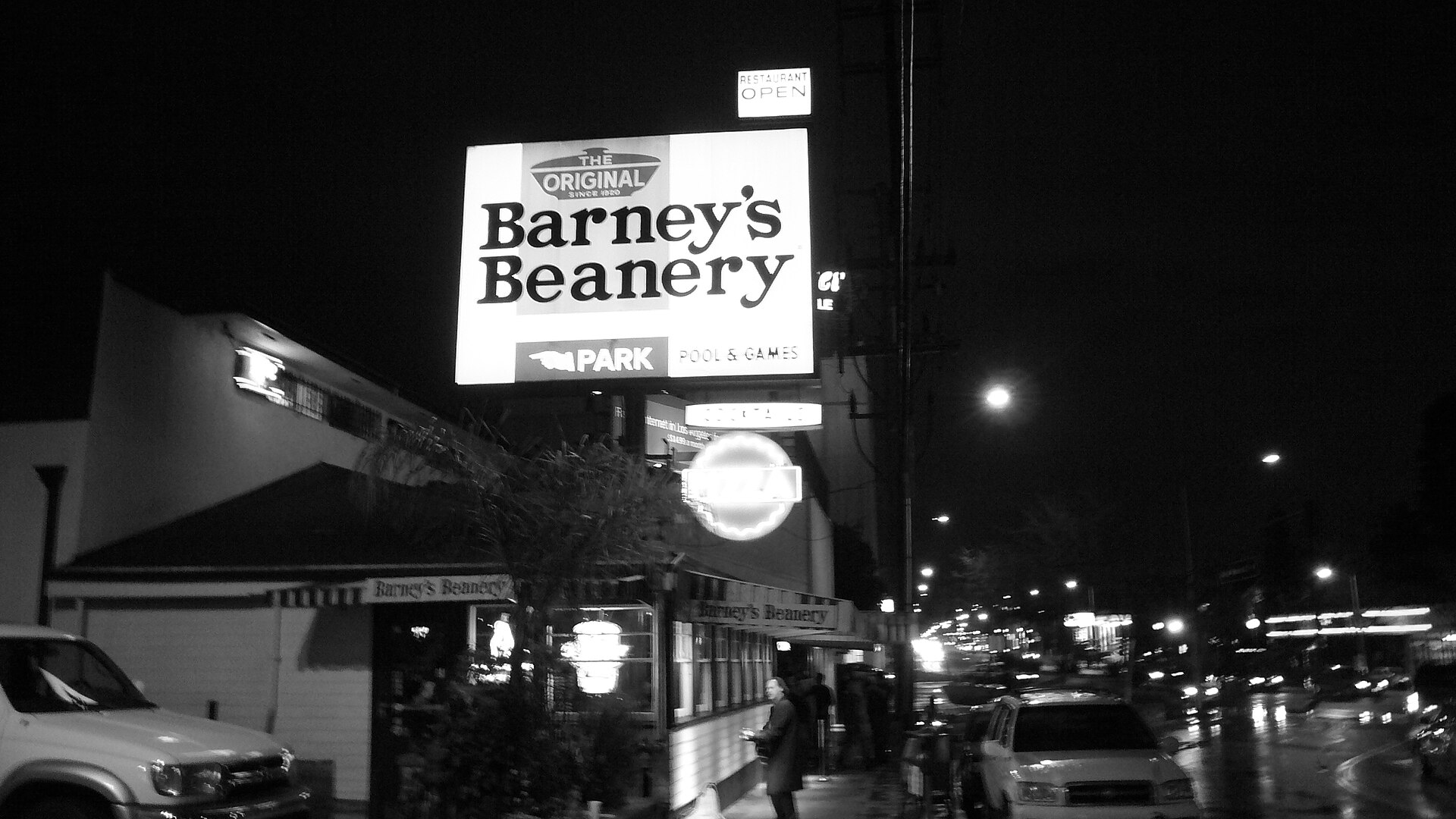
The real Barney’s traces its beginnings to a chili stand in 1920. Its West Hollywood room became a gathering place for artists and musicians.
It also displayed a sign excluding gay people. Activists fought that discrimination for years. After West Hollywood became a city in 1984, the new city government acted and the sign came down.
Find the bar and the artwork
Start at the original Barney’s at 8447 Santa Monica Boulevard, or follow the artwork to its museum. Check each official website before visiting.
How we reported this · 12 sources
- Press coverage: en.wikipedia.org
- The venue's website: barneysbeanery.com
- The venue's website: barneysbeanery.com
- Press coverage: en.wikipedia.org
- Press coverage: en.wikipedia.org
- Press coverage: en.wikipedia.org
- Press coverage: en.wikipedia.org
- Press coverage: en.wikipedia.org
- Press coverage: timeout.com
- Press coverage: weho.org
- Press coverage: s3-eu-west-1.amazonaws.com
- Press coverage: lalouver.com
Pull a thread
Where this story goes next
He sorted mail for over a decade, quit at 49 to write full time, and later renamed Werner Herzog "Wenner Zergog" in a novel.
Person
Charles Bukowski
Andernach to Mid-City
He was born Heinrich Karl Bukowski in Andernach, Germany, on August 16, 1920. His family sailed for Baltimore in 1923 and moved to Mid-City, Los Angeles, in 1930. He finished high school in 1939 and spent two years at Los Angeles City College before quitting at the start of the Second World War.
He decided to starve
In the early 1950s he worked as a fill-in letter carrier, and by 1960 he was back at the Los Angeles post office as a filing clerk, a job he held for more than a decade; Discover Los Angeles places him at the Terminal Annex on Alameda Street. In 1969, at 49, he took the publisher John Martin's offer and quit to write full time. He later wrote that he had "decided to starve." He finished the novel Post Office less than a month after leaving, and it came out in 1971.
Bukowski Court
In the 1960s and 1970s he lived in a run of apartments in what is now Thai Town. The best known is 5124 De Longpre Avenue, which Discover Los Angeles says he rented for $29 a month and where he wrote Post Office and Factotum. When it was threatened with demolition in 2007, fans saved it, and the city named it Historic-Cultural Monument 912, Bukowski Court. Nearby, Pink Elephant Liquors on Western Avenue delivered, which let him skip the drive and keep writing; its mid-century neon sign is still up.
Hollywood, renamed
He wrote the screenplay for Barfly (1987), with Mickey Rourke playing his alter ego, Henry Chinaski, opposite Faye Dunaway. Then he wrote a novel about making it, Hollywood (1989), with everyone renamed: Sean Penn became Tom Pell, Francis Ford Coppola became Frances Ford Lopalla, and Werner Herzog became Wenner Zergog. By then, Discover Los Angeles says, there was money for Musso & Frank, where he entertained Penn and Dennis Hopper, and for Hollywood's older bars, including the Frolic Room beside the Pantages.
Over the register
The Frolic Room "proudly proclaims its Buk association," Discover Los Angeles wrote in 2026. A framed photo of him hangs over the register, Scoundrel's Field Guide reports, and the Hollywood Partnership reported in 2017 that the bar once held weekly readings of his work. Time magazine called him a "laureate of American lowlife." He died in San Pedro on March 9, 1994, at 73, and his gravestone at Green Hills Memorial Park reads "Don't Try."
Now · As of August 2026, Discover Los Angeles found the Frolic Room still proclaiming its Bukowski connection, with his photo reportedly over the register, and Bukowski Court still standing on De Longpre Avenue as a city Historic-Cultural Monument.
- Frolic Room A regular; his photo hangs over the register
- Musso & Frank Grill Where he entertained Sean Penn and Dennis Hopper 1980s
- Ruben Rueda The Musso & Frank waiter who drove him home
- Hollywood The town he put in a novel, under another name
Hollywood began as a town that voted to ban liquor sales. Six years later it joined Los Angeles, for the water.
Place
Hollywood
A town that voted itself dry
Harvey Wilcox filed the name Hollywood with the county recorder in 1887; his wife, Daeida, said she chose it because it sounded nice and holly brings good luck. Hollywood incorporated as its own city in November 1903, by a vote of 88 to 77. Two months later its voters banned liquor sales except for medicine, 113 to 96, so its hotels and restaurants couldn't serve so much as a glass of wine with dinner. The independence didn't last. Hollywood merged with Los Angeles in February 1910 to get a reliable water supply and the city's sewers, and most of Prospect Avenue became Hollywood Boulevard.
Older than the sign
Frank's Cafe, the restaurant that became Musso & Frank, opened on Hollywood Boulevard on September 27, 1919, less than four months before national Prohibition began; one centennial history says the boulevard was still a dirt road. The HOLLYWOODLAND sign went up in the hills in 1923 to sell a housing development, and lost its last four letters in 1949. NPR, marking Musso's centennial, noted the restaurant is older than the sign. The Walk of Fame officially opened in 1960; in 2019 Musso & Frank got a star on it (Wikipedia calls it the first restaurant to receive one).
The writers' block
In the 1930s the studios brought the country's novelists to Hollywood, and the Screen Writers Guild kept offices across the boulevard from Musso & Frank. Stanley Rose's bookshop sat next door to the restaurant, and Alta reported that its owner held literature seminars in a space that housed slot machines. The novelists, as Mark Echeverria tells it, complained at the Guild and then crossed the street to drink at Musso's.
Now · Musso & Frank is still at 6667 Hollywood Boulevard, run by the family of John Mosso, who bought into it in 1927. Its website lists dinner Tuesday to Sunday.
- Musso & Frank Grill Hollywood's oldest restaurant, on the boulevard since 1919
- The Back Room at Musso & Frank Where the studios' novelists drank 1934-1955
- Frolic Room A 1930s bar on the boulevard, next door to the Pantages
- Charles Bukowski Drank on the boulevard, at Musso's among other bars
- The Magic Castle The magicians' clubhouse in a 1909 Hollywood mansion
- Avalon Hollywood The 1927 theater on Vine that became a nightclub
- Roscoe's House of Chicken 'N Waffles Chicken and waffles on Gower
- Yamashiro The 1914 replica of a Japanese palace in the hills above
A pier bartender, a think tank landlord and a park that wanted a bar's spot: Santa Monica's nights run through one block of Ocean Avenue.
Place
Santa Monica
From the pier to Ocean Avenue
In the 1950s Jay Fiondella was an actor hustling for small parts and tending bar at Sinbad's, on the Santa Monica Pier. He ate breakfast at a struggling coffee shop up on Ocean Avenue, the Dawn Cafe, and in 1959 he took it over and made it Chez Jay. It sits at 1657 Ocean Avenue, in a building the Santa Monica Conservancy dates to 1947. Its portholes, the Santa Monica Conservancy says, came from a pre-war gambling ship seized in Santa Monica Bay.
The think tank landlord
Santa Monica was also home to the RAND Corporation, and the Los Angeles Times reported that the think tank was Chez Jay's landlord. Henry Kissinger conferred with RAND researchers in the back so often that a rear table was nicknamed the Kissinger Room. Daniel Ellsberg worked at RAND too, which is how the city's best bar rumor was born: that he passed the Pentagon Papers to a reporter at Table 10. Nobody has proved it.
The park next door
In 1999 the city's redevelopment agency bought Chez Jay and the land around it for a new civic center park. State lawmakers and courts abolished redevelopment agencies in February 2012, which left the land with a successor agency and the bar's future unclear. The city's park plan wanted a casual restaurant that opened onto it. Regulars got Chez Jay landmarked in October 2012 instead, and Tongva Park opened beside it in 2013.
Now · Chez Jay is open on Ocean Avenue, and its outdoor sister, The Backyard at Chez Jay, sits beside Tongva Park with fire pits and live music on Wednesday nights, by the restaurant's 2026 site.
- Chez Jay The peanut bar half a block from the pier since 1959
- Harvelle's Another Santa Monica night out in our stories
It was county land, out of the LAPD's reach, and gambling that was illegal in the city of LA was legal here.
Place
Sunset Strip
County land
The Strip runs 1.7 miles along Sunset Boulevard, from near Marmont Lane at the Los Angeles border to Phyllis Street at Beverly Hills. Until West Hollywood incorporated in November 1984 it was unincorporated Los Angeles County, outside LAPD jurisdiction, and gambling that was illegal in the city of Los Angeles was legal there, by Wikipedia's account. Movie people filled Ciro's, the Mocambo, the Trocadero and Sherry's in the 1930s and 1940s, and writers lived at the Garden of Allah.
Rock, riots and metal
By the mid-1960s the Strip was the center of LA's young music scene, with the Byrds, the Doors and Frank Zappa playing Gazzarri's, the Whisky a Go Go, the London Fog and Pandora's Box; go-go dancers arrived in July 1965. A 10 p.m. youth curfew brought the November 1966 riots and Buffalo Springfield's "For What It's Worth." In the 1970s Rodney Bingenheimer's English Disco drew glam rockers, and in the 1980s Van Halen, Mötley Crüe, Ratt and Guns N' Roses made it the home of LA metal.
Sixty years on
For the riots' 50th anniversary, West Hollywood showed an exhibition of photographs by Henry Diltz titled with words from "For What It's Worth," and talks including one by Domenic Priore, author of Riot on Sunset Strip: Rock 'n' Roll's Last Stand in Hollywood.
Now · The Whisky a Go Go (8901 Sunset, which calls itself a landmark "since 1964") lists shows into late November 2026, including November 12. The Rainbow Bar & Grill (9015 Sunset, since 1972) lists hours to 2 a.m. daily, and the Comedy Store (8433 Sunset) lists shows through at least October 28, 2026.
- West Hollywood The city the Strip runs through since 1984
- Whisky a Go Go Rock club on the Strip since 1964
- Rainbow Bar & Grill Rock bar on the Strip since 1972
- The Comedy Store Comedy club on the Strip
1 more thread
It's been a city only since 1984. Before that, the county border is why Sunset's nightclubs could do what LA wouldn't allow.
Place
West Hollywood
Outside the city's reach
For decades this was unincorporated county land wrapped by Los Angeles. A railroad town called Sherman fought off annexation and took the name West Hollywood in 1925 while staying under county rule. Gambling was illegal in the city of Los Angeles but legal in the county, so casinos and nightclubs multiplied along Sunset Boulevard in the 1920s, mostly out of the LAPD's reach. That is the seed of the Sunset Strip.
A city in 1984
West Hollywood incorporated on November 29, 1984, after a coalition of gay men, Russian Jewish émigrés and older renters voted for it when county rent control expired. The new council was the first in the country with a gay majority, and Valerie Terrigno was its first mayor. Today it holds about 35,757 people on 1.89 square miles.
The rooms
The city counts the Whisky a Go Go, the Roxy, the Viper Room, the Comedy Store, the Rainbow Bar and Grill, the Formosa Cafe and the Troubadour among its rooms. On Santa Monica Boulevard, a few doors from the Troubadour, Dan Tana's has served Italian food in a 1929 bungalow since 1964; Visit West Hollywood calls it a Route 66 landmark.
- Dan Tana's Italian since 1964 on Santa Monica Boulevard since 1964
- The Troubadour The Troubadour, a few doors down since 1961
- Whisky a Go Go On the Sunset Strip
- Rainbow Bar & Grill On the Sunset Strip
- The Comedy Store On the Sunset Strip
- Formosa Cafe On Santa Monica Boulevard
- Sunset Strip The nightlife strip the county border made possible
- Doug Weston Built the Troubadour here