
Kuya Lord · East Hollywood, Los Angeles
The restaurant began before it had a dining room.
Lord Maynard Llera and his wife, Gigi, cooked through pop-ups, a home kitchen and a pandemic before opening Kuya Lord.
Before Kuya Lord had a restaurant, Lord Maynard Llera and his wife, Gigi, sold food through Los Angeles pop-ups.
When the pandemic hit, the couple kept cooking from home, using their garage and backyard. Their food could reach customers without a dining room.
Cooking something of their own
Llera had worked in restaurant kitchens for years. His route through the United States included a job at Jollibee and a place on the opening team at Bestia.
Kuya Lord gave him and Gigi a way to cook food with a more personal center: the southern Tagalog region of the Philippines, including the area around Lucena where he grew up.
“Kuya” is a Filipino term used for an older brother. The name makes the invitation feel personal before a plate arrives.
A place inside a dish
One signature is Lucenachon: rolled pork belly with crisp skin. The name joins Lucena with lechon, the Filipino tradition of roasted pork.
Another is pancit chami, a noodle dish associated with Lucena. These dishes give diners somewhere specific to begin. “Filipino food” opens into a particular place, a family and a cook’s memories.
In June 2022, the couple opened their permanent restaurant on Melrose Avenue. In 2024, Llera received the James Beard Award for Best Chef: California.
The award is a visible milestone. The less visible part is all the cooking that made a restaurant possible before it had a front door.
Find the place
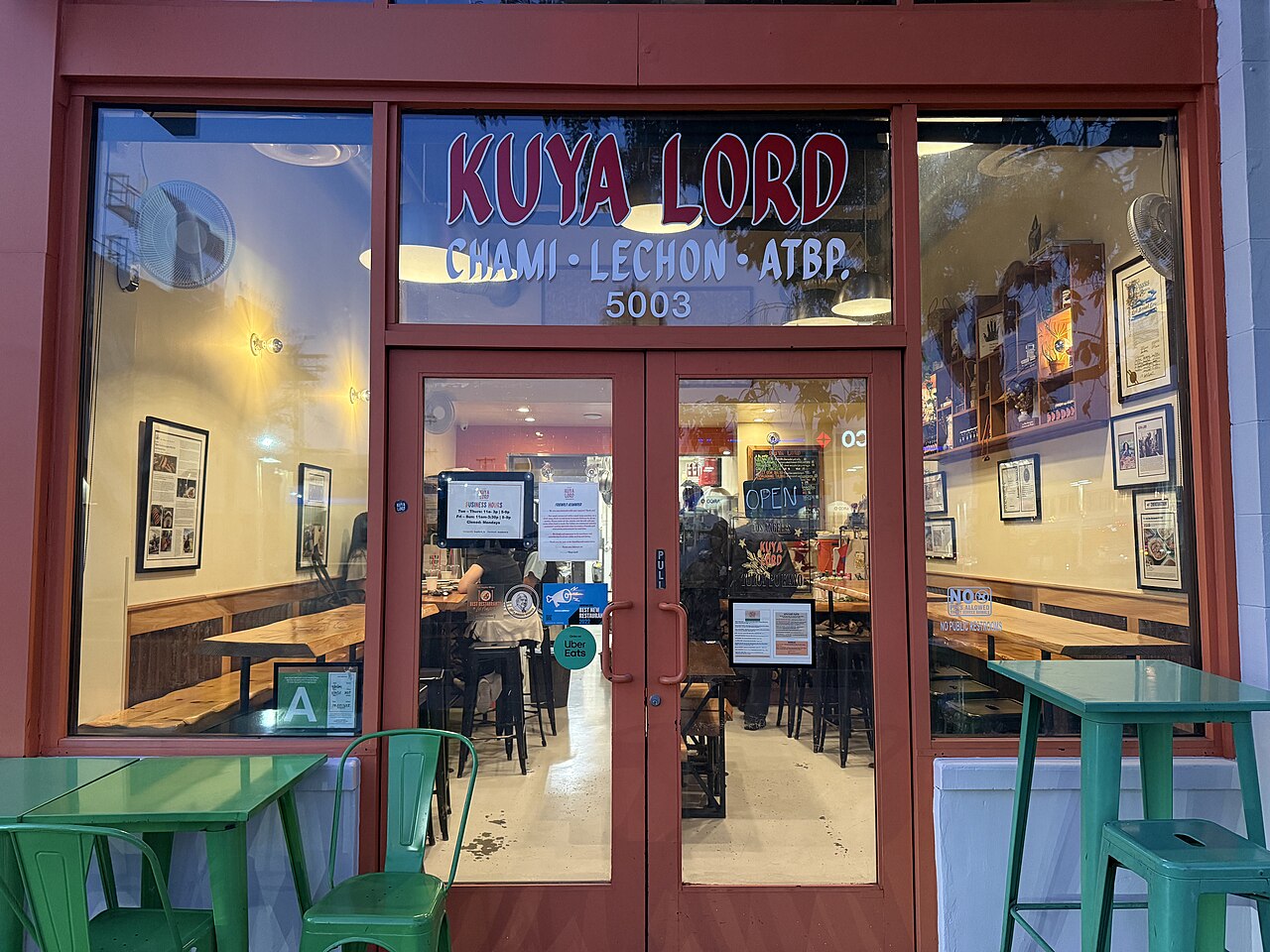
Kuya Lord is at 5003 Melrose Avenue. Check its official site before going; private events and special collaborations can change regular service days.
How we reported this · 6 sources
- The venue's website: kuyalord.com
- Press coverage: en.wikipedia.org
- Press coverage: theinfatuation.com
- Press coverage: voyagela.com
- Press coverage: timeout.com
- Press coverage: en.wikipedia.org
Pull a thread
Where this story goes next
A gin cocktail called the Saturn. A family bar on Sunset. Follow the Filipino bartenders behind them.
Movement
Tiki's Filipino bartenders
First, what is tiki?
Here, tiki means an American style of cocktail bar: elaborate tropical drinks, often made with rum, citrus and spices, served in rooms designed as imaginary island escapes. The drinks draw on Caribbean recipes; the décor borrows from Pacific cultures. That themed setting is an American invention, rather than a picture of everyday life in Polynesia.
Follow the people behind the glass
Filipino bartenders helped make those drinks, develop new ones and carry the craft between bars. At Don the Beachcomber, a Hollywood bar and restaurant, that circle included Ray Buhen, Conrad Laserna and Mariano Licudine. Their working lives offer several ways into the story.
A Saturn, a Black Magic, a bar of your own
Mariano Licudine, born in Manila, became the leading bartender at the Mai-Kai, a tropical restaurant in Fort Lauderdale, Florida. He created cocktails called the Derby Daiquiri and the Black Magic. Popo Galsini created the Saturn, a gin cocktail from late-1960s California. Ray Buhen took another path: in 1961, he opened Tiki-Ti in Los Angeles, beginning a family business. A drink recipe can carry a person's work far beyond the room where it began.
The craft travelled
Bob Esmino and Ray Barrientos helped open branches of the Kon-Tiki restaurant chain across North America. Bobby Batugo, working at Tip's in Valencia, California, won multiple bartenders' guild awards. These were careers built around skill: creating recipes, running bars and earning recognition for the work.
How they came to Los Angeles
Many of these careers began with a much longer journey. In the early 1920s, thousands of young Filipino men travelled to the US on freighters from Manila. In Los Angeles they found domestic and service work. By 1933 the county was home to nearly a fifth of the 65,000 Filipinos new to the country, according to historian Linda España-Maram.
The names they worked under
Some adopted English names. Carina Monica Montoya's father, a waiter and bartender at Don the Beachcomber, went from Tomas to Tommy and dressed like film star Clark Gable. Nash Aranas, born on the Philippine island of Panay, shortened Ananias to Nash. He began as a bar assistant at the Beachcomber and rose to an executive role across the chain.
The barriers around that work
Their achievements also sit inside a harder history. Cocktail historian Jeff Berry has described white men receiving bartending jobs ahead of skilled Filipino workers. In 1933, Salvador Roldan won a court ruling allowing him to marry a white woman; California then changed its marriage law to include Filipinos in the ban. That restriction lasted until 1948. In 1946, when Aranas and his Polish American wife, Helen, bought a house in Filipinotown, Helen's sister had to put her name on the deed.
- Ray Buhen Follow Ray from the Beachcomber to a family bar of his own from 1934
- Don the Beachcomber Step inside the Hollywood bar where these careers crossed 1930s
- Donn Beach Meet the operator behind the drinks and the island fantasy 1930s
- Tiki-Ti A Filipino bartender's own bar, still in the family since 1961
After years making other people’s tropical drinks, the Filipino bartender built a small bar of his own.
Tiki-Ti · Los Feliz, Los Angeles
Ray Buhen wanted customers to see who made their drinks
After years making other people’s tropical drinks, the Filipino bartender built a small bar of his own.
Read the storyA rap writer at an alt-weekly started reviewing places nobody else covered. In 2007 it won the Pulitzer.
Work
Counter Intelligence
The column
Gold started Counter Intelligence at LA Weekly in 1986, with reluctant support from the paper's founder, Jay Levin, reviewing under-the-radar restaurants in the city's ethnic neighborhoods. The column moved with him to the Los Angeles Times from 1990 to 1996, and he revived it at the Weekly in 2001. The book, Counter Intelligence: Where to Eat in the Real Los Angeles, came out in 2000.
99, then 101
His yearly guide, Jonathan Gold's 99 Essential LA Restaurants, became Jonathan Gold's 101 Best Restaurants after he returned to the Times. The 2007 Pulitzer citation praised his "zestful, wide ranging restaurant reviews, expressing the delight of an erudite eater."
- Jonathan Gold His column
Its bottles lost their labels to letters and numbers, so even the bartenders couldn't memorize the recipes.
Venue
Don the Beachcomber
Thirteen feet by thirty
The first one was a former tailor shop at 1722 North McCadden Place, just off Hollywood Boulevard: 13 feet by 30, leased for $30 a month, with a bar for about two dozen people and rum drinks for a quarter. Sources split on the year, 1933 or 1934; both fall at the end of Prohibition. A New York Tribune writer, Neil Vanderbilt, liked his Sumatra Kula enough to come back with friends, Charlie Chaplin among them.
Letters instead of labels
Donn's recipes often ran to ten ingredients or more. He soldered the spouts of glass cruets to control the bitters and sawed jiggers down to quarter-, half- and three-quarter-ounce sizes. By 1948, the Saturday Evening Post reported, the bottles behind his bar had lost their labels to cryptic letters and numbers, and the bartenders worked from coded recipes so the service-bar help couldn't memorize them. The Zombie was born here, with the help of his Filipino bartenders; KCET reported it was so strong there was a limit of two per customer.
Sixteen restaurants, then none
In 1937 it moved across the street to 1727 North McCadden and grew into a restaurant, with rain on a tin roof and a gardenia lei for the loveliest lady in the room at midnight. While Donn was at war, his ex-wife and partner, Sunny Sund, built it into a chain with branches in Chicago, Palm Springs and Las Vegas and, at its height, 16 restaurants. It was sold to Getty Enterprises in 1968, and the original Hollywood location closed in 1985.
Now · The Hollywood original closed in 1985, and Time Out reports that the last Don the Beachcomber in California closed in 2018. Its Zombie outlived it: Tiki-Ti's 2026 menu pours its own version and credits the original to Don the Beachcomber, 1934.
- Donn Beach Its founder, who took its name as his own from 1933
- Ray Buhen Mixed in its back room from 1934
- Tiki's Filipino bartenders Its bar and service staff were overwhelmingly Filipino 1930s
- Who invented the Mai Tai? Where Donn Beach's side says the Mai Tai began
- Tiki-Ti Where its Zombie is still poured since 1961
2 more threads
Before he was Donn Beach he was Ernest Gantt, broke and parking cars in LA. Filipino friends put him up, and he promised to hire them all.
Person
Donn Beach
The promise
Ernest Raymond Beaumont Gantt reached Southern California in December 1931, 24 and out of money. By his own telling he had drifted through Jamaica, Tahiti, Australia and Papua New Guinea; KCET called him a spinner of tall tales. In Los Angeles he parked cars, worked in restaurants and, American Heritage reports, did a bit of bootlegging before Prohibition ended. Jeff Berry has said that Filipino workers put him up, and that Gantt promised that when he got his own place, he would hire all of them. When his bar opened, its bar and service staff were overwhelmingly Filipino.
A U-boat, then Waikiki
In the Second World War he was commissioned, and his ship, in a convoy bound for Morocco, was attacked by a U-boat. He was hurt, then spent the rest of the war running rest hotels for airmen on Capri, in Venice and on the French Riviera. Back home, he found that his ex-wife and business partner, Sunny Sund, had turned Don the Beachcomber into a chain. He signed the mainland restaurants over to her, stayed on as a consultant and left for Waikiki, where he opened his own Don the Beachcomber, ran his business from an office in a banyan tree and kept a myna bird trained to squawk "Give me a beer, stupid!"
Eighty-four drinks
He died in Honolulu in 1989. The New York Times obituary, as American Heritage describes it, painted him as a sort of Thomas Edison of the thatched-roof bar and credited him with 84 drinks, including the Mai Tai. That last credit is still argued over.
- Don the Beachcomber The bar he opened, and the name he took from 1933
- Ray Buhen One of his first bartenders from 1934
- Tiki's Filipino bartenders Hired the Filipino friends who had put him up 1930s
- Who invented the Mai Tai? His widow said he had a Mai Tai first
- Tiki-Ti Where his Zombie is still poured since 1961
Hollywood began as a town that voted to ban liquor sales. Six years later it joined Los Angeles, for the water.
Place
Hollywood
A town that voted itself dry
Harvey Wilcox filed the name Hollywood with the county recorder in 1887; his wife, Daeida, said she chose it because it sounded nice and holly brings good luck. Hollywood incorporated as its own city in November 1903, by a vote of 88 to 77. Two months later its voters banned liquor sales except for medicine, 113 to 96, so its hotels and restaurants couldn't serve so much as a glass of wine with dinner. The independence didn't last. Hollywood merged with Los Angeles in February 1910 to get a reliable water supply and the city's sewers, and most of Prospect Avenue became Hollywood Boulevard.
Older than the sign
Frank's Cafe, the restaurant that became Musso & Frank, opened on Hollywood Boulevard on September 27, 1919, less than four months before national Prohibition began; one centennial history says the boulevard was still a dirt road. The HOLLYWOODLAND sign went up in the hills in 1923 to sell a housing development, and lost its last four letters in 1949. NPR, marking Musso's centennial, noted the restaurant is older than the sign. The Walk of Fame officially opened in 1960; in 2019 Musso & Frank got a star on it (Wikipedia calls it the first restaurant to receive one).
The writers' block
In the 1930s the studios brought the country's novelists to Hollywood, and the Screen Writers Guild kept offices across the boulevard from Musso & Frank. Stanley Rose's bookshop sat next door to the restaurant, and Alta reported that its owner held literature seminars in a space that housed slot machines. The novelists, as Mark Echeverria tells it, complained at the Guild and then crossed the street to drink at Musso's.
Now · Musso & Frank is still at 6667 Hollywood Boulevard, run by the family of John Mosso, who bought into it in 1927. Its website lists dinner Tuesday to Sunday.
- Musso & Frank Grill Hollywood's oldest restaurant, on the boulevard since 1919
- The Back Room at Musso & Frank Where the studios' novelists drank 1934-1955
- Frolic Room A 1930s bar on the boulevard, next door to the Pantages
- Charles Bukowski Drank on the boulevard, at Musso's among other bars
- The Magic Castle The magicians' clubhouse in a 1909 Hollywood mansion
- Avalon Hollywood The 1927 theater on Vine that became a nightclub
- Roscoe's House of Chicken 'N Waffles Chicken and waffles on Gower
- Yamashiro The 1914 replica of a Japanese palace in the hills above