
The Apple Pan · West LA, Los Angeles
He turned down the job. The owner kept asking.
Hector Morales’s route behind the Apple Pan counter shows how a neighborhood institution is built through people, as much as recipes.
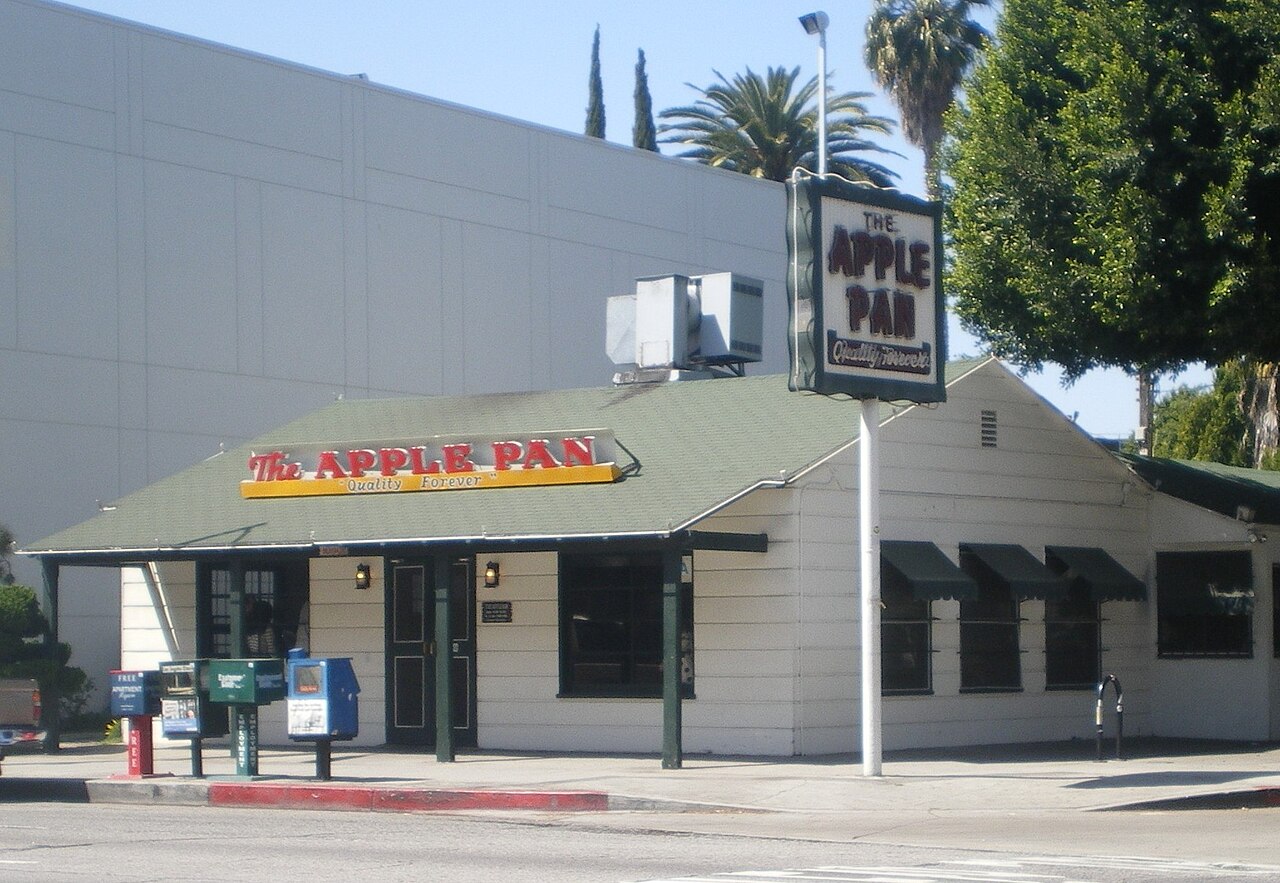
Hector Morales did not want the job.
He answered an advertisement at the Apple Pan in 1976, then learned it meant working nights. He declined.
Owner Alan Baker kept trying. More money helped. So did being paid during the restaurant’s annual monthlong closure. Morales took the job.
He was still working there when the Los Angeles Times interviewed him in 2017.
The person on the other side of the counter
In a 2017 Los Angeles Times interview, Morales described friendships with customers that had led to shared meals in cities around the world.
The little restaurant on Pico Boulevard had given him a much larger circle.
Alan and Ellen Baker opened it in 1947. Family recipes became its burgers and pies. A U-shaped counter put customers near the grill and near the people serving them.
Regulars developed preferences that went beyond the food: which side to sit on, whose section to wait for.
What does keeping it the same require?
The Bakers’ granddaughter sold the business in 2019 to longtime customers Shelli and Irving Azoff.
The promise was continuity. Then the pandemic made adaptation urgent.
The Apple Pan began taking cards, developed pickup service and added outdoor seating. New pies joined the menu. Some old serving details changed.
That does not erase what people came for. It shows that preserving a restaurant requires choices about what matters most.
The recipes matter. So do the workers who know how a regular likes an order and the counter where that recognition happens.
Other businesses have copied the Apple Pan’s appearance. Reproducing the relationships takes longer.
Find the place
The Apple Pan is at 10801 West Pico Boulevard. Its official site lists current hours, the menu and pickup or delivery options.
How we reported this · 14 sources
- The venue's website: theapplepan.com
- The venue's website: theapplepan.com
- Press coverage: latimes.com
- Press coverage: latimes.com
- Press coverage: latimes.com
- Press coverage: laist.com
- Press coverage: abc7.com
- Press coverage: floodmagazine.com
- Press coverage: tastingtable.com
- Press coverage: timeout.com
- Press coverage: en.wikipedia.org
- Press coverage: fundinguniverse.com
- Press coverage: iamnotastalker.com
- Public record: cinematreasures.org
Pull a thread
Where this story goes next
He started as a proofreader, interviewed Dr. Dre, and is buried under the words "Tacos Forever."
Person
Jonathan Gold
From proofreader to rap writer
Gold was born in Los Angeles on July 28, 1960. As a UCLA freshman he briefly worked at a kosher restaurant owned by Leah Adler, Steven Spielberg's mother. In 1982 he became a proofreader at LA Weekly, where he met his future wife, Laurie Ochoa, then moved to the music section, writing about classical music and hip-hop and interviewing Snoop Dogg, Dr. Dre and members of N.W.A.
The critic in the strip mall
He started Counter Intelligence in 1986, wrote for the Los Angeles Times from 1990 to 1996, went to New York for Gourmet in 1999 and came back in 2001. In 2007 he became the first food critic to win the Pulitzer Prize for Criticism, for his LA Weekly reviews, and in 2012 he became the Times' chief critic. Anthony Bourdain said he was the first to turn the focus from white tablecloths to "really cool little places in strip malls." LAist wrote that he saw the city as a mosaic, an "anti-melting pot."
No notebook at the table
He would not take notes at dinner: "Taking notes while you're eating is like taking notes while you're making love." LAist recalled him returning to one Taiwanese restaurant 16 or 17 times. "There are definitely moments when you're eating with me that I will be in a trance state," he said. Los Angeles Magazine wrote that he gave the same attention to trucks and stands as to fine dining.
Tacos Forever
Gold died of pancreatic cancer on July 21, 2018, at 57. On July 28, his birthday, buildings and landmarks across Los Angeles were lit in gold. The James Beard Foundation renamed its Local Impact Award the Jonathan Gold Local Voice Award, and in 2019 gave him a posthumous award. He is buried at Hollywood Forever Cemetery under the epitaph "Tacos Forever."
- Counter Intelligence His column and book 1986-2018
- Jitlada Championed Tui Sungkamee's Southern Thai cooking
- Guelaguetza A family restaurant he championed, per the James Beard Foundation
- King Taco #1 Called its tacos "solid B+ tacos" and said it may have set the modern LA taco sensibility 2013
It's been a city only since 1984. Before that, the county border is why Sunset's nightclubs could do what LA wouldn't allow.
Place
West Hollywood
Outside the city's reach
For decades this was unincorporated county land wrapped by Los Angeles. A railroad town called Sherman fought off annexation and took the name West Hollywood in 1925 while staying under county rule. Gambling was illegal in the city of Los Angeles but legal in the county, so casinos and nightclubs multiplied along Sunset Boulevard in the 1920s, mostly out of the LAPD's reach. That is the seed of the Sunset Strip.
A city in 1984
West Hollywood incorporated on November 29, 1984, after a coalition of gay men, Russian Jewish émigrés and older renters voted for it when county rent control expired. The new council was the first in the country with a gay majority, and Valerie Terrigno was its first mayor. Today it holds about 35,757 people on 1.89 square miles.
The rooms
The city counts the Whisky a Go Go, the Roxy, the Viper Room, the Comedy Store, the Rainbow Bar and Grill, the Formosa Cafe and the Troubadour among its rooms. On Santa Monica Boulevard, a few doors from the Troubadour, Dan Tana's has served Italian food in a 1929 bungalow since 1964; Visit West Hollywood calls it a Route 66 landmark.
- Dan Tana's Italian since 1964 on Santa Monica Boulevard since 1964
- The Troubadour The Troubadour, a few doors down since 1961
- Whisky a Go Go On the Sunset Strip
- Rainbow Bar & Grill On the Sunset Strip
- The Comedy Store On the Sunset Strip
- Formosa Cafe On Santa Monica Boulevard
- Sunset Strip The nightlife strip the county border made possible
- Doug Weston Built the Troubadour here