
Bob Baker Marionette Theater · Highland Park, Los Angeles
How do you move a theater with thousands of puppets?
Bob Baker and Alton Wood gave Los Angeles a home for puppets. The people who followed them carried the theater into its next chapter.
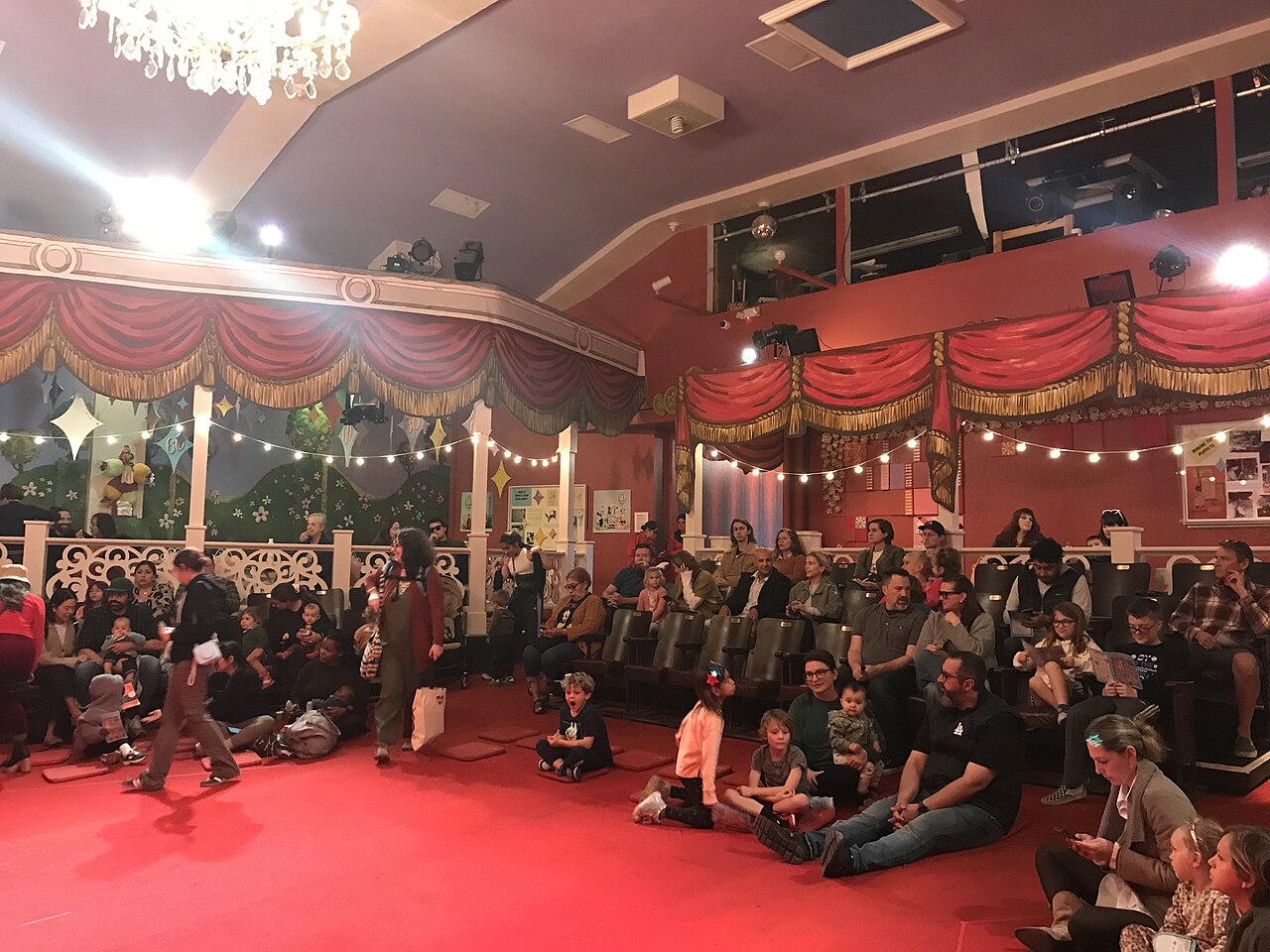
Bob Baker Marionette Theater had to leave its longtime home on West First Street. The staff packed the puppets and moved the show to Highland Park.
They were moving a collection built over decades. Some of the puppets still performed today date to the 1940s.
First, a boy saw a show
In 1930, Bob Baker watched a puppet show in Los Angeles. Soon he had a small theater in his family’s backyard. By eight, he was performing professionally.
A marionette is a puppet moved by strings. A person works those strings to make it walk, turn or dance. The little figure needs someone else’s skill to come alive.
Baker and his partner Alton Wood bought a former scenery workshop in 1961. Their theater opened in 1963. They had made a permanent home for a craft built around movement.
Keeping the show alive took work
The theater’s history includes real financial pressure. The Los Angeles Conservancy records that donors helped avert closure in 2008. A later sale gave the company a lease on its original space.
After Baker died in 2014, the staff became the people responsible for carrying the theater forward. Its own history describes packing the collection and moving from West First Street to Highland Park.
The move carried more than objects. Each puppet held work by the people who had designed, made, repaired and performed it.
The strings are still moving
The theater’s current FAQ describes a collection of more than 3,000 puppets. Some date to the 1940s; new ones are still being made. A production uses around 100 handcrafted figures.
The show also ends with ice cream, according to the theater. There is room for both a living craft and a very good afternoon.
Find the place
The theater is at 4949 York Boulevard in Highland Park. Use its official show calendar and visitor guide for dates, tickets and seating. West First Street is the historic location, not the address for today’s visit.
How we reported this · 11 sources
- The venue's website: bobbakermarionettetheater.com
- The venue's website: bobbakermarionettetheater.com
- The venue's website: bobbakermarionettetheater.com
- The venue's website: bobbakermarionettetheater.com
- Press coverage: en.wikipedia.org
- Press coverage: laconservancy.org
- Press coverage: nbclosangeles.com
- Press coverage: lamag.com
- Press coverage: thelalocal.org
- Press coverage: thewrap.com
- The venue's website: bobbakermarionettetheater.com
Pull a thread
Where this story goes next
Bobby Green once went to punk shows at Mr. T’s Bowl without noticing the lanes. Years later, his team helped bring them back.
Highland Park Bowl · Highland Park, Los Angeles
The bowling alley was behind a curtain.
Bobby Green once went to punk shows at Mr. T’s Bowl without noticing the lanes. Years later, his team helped bring them back.
Read the storyHollywood began as a town that voted to ban liquor sales. Six years later it joined Los Angeles, for the water.
Place
Hollywood
A town that voted itself dry
Harvey Wilcox filed the name Hollywood with the county recorder in 1887; his wife, Daeida, said she chose it because it sounded nice and holly brings good luck. Hollywood incorporated as its own city in November 1903, by a vote of 88 to 77. Two months later its voters banned liquor sales except for medicine, 113 to 96, so its hotels and restaurants couldn't serve so much as a glass of wine with dinner. The independence didn't last. Hollywood merged with Los Angeles in February 1910 to get a reliable water supply and the city's sewers, and most of Prospect Avenue became Hollywood Boulevard.
Older than the sign
Frank's Cafe, the restaurant that became Musso & Frank, opened on Hollywood Boulevard on September 27, 1919, less than four months before national Prohibition began; one centennial history says the boulevard was still a dirt road. The HOLLYWOODLAND sign went up in the hills in 1923 to sell a housing development, and lost its last four letters in 1949. NPR, marking Musso's centennial, noted the restaurant is older than the sign. The Walk of Fame officially opened in 1960; in 2019 Musso & Frank got a star on it (Wikipedia calls it the first restaurant to receive one).
The writers' block
In the 1930s the studios brought the country's novelists to Hollywood, and the Screen Writers Guild kept offices across the boulevard from Musso & Frank. Stanley Rose's bookshop sat next door to the restaurant, and Alta reported that its owner held literature seminars in a space that housed slot machines. The novelists, as Mark Echeverria tells it, complained at the Guild and then crossed the street to drink at Musso's.
Now · Musso & Frank is still at 6667 Hollywood Boulevard, run by the family of John Mosso, who bought into it in 1927. Its website lists dinner Tuesday to Sunday.
- Musso & Frank Grill Hollywood's oldest restaurant, on the boulevard since 1919
- The Back Room at Musso & Frank Where the studios' novelists drank 1934-1955
- Frolic Room A 1930s bar on the boulevard, next door to the Pantages
- Charles Bukowski Drank on the boulevard, at Musso's among other bars
- The Magic Castle The magicians' clubhouse in a 1909 Hollywood mansion
- Avalon Hollywood The 1927 theater on Vine that became a nightclub
- Roscoe's House of Chicken 'N Waffles Chicken and waffles on Gower
- Yamashiro The 1914 replica of a Japanese palace in the hills above